
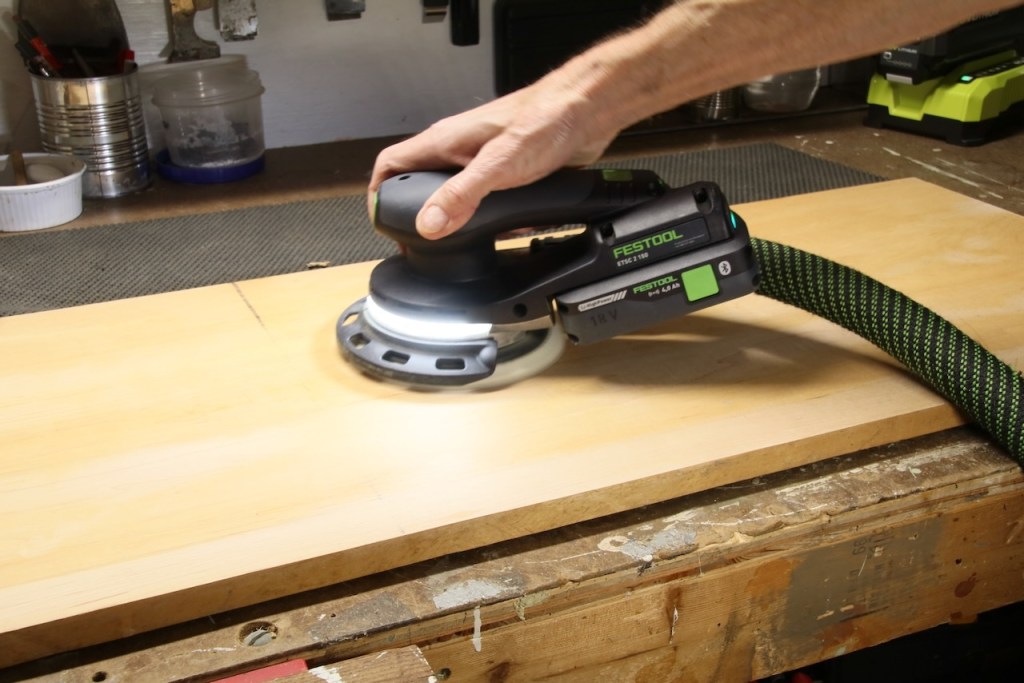
I was helping a young tradesman load in his power tools recently when I noticed that not even one was of the plug-in variety. I bought my first cordless drill (Skil 9.6V) in 1985, and I’ve steadily built up a significant arsenal of battery-powered devices. But I never considered cutting the cord for operations that demand long runtime or generate significant amounts of dust, especially power sanding.
When Festool announced the release of the first cordless model in its highly regarded line of random orbit (RO) sanders, I was eager to find out if it could change my mind.
Options
The ETSC 2 features a brushless motor with a 3.5mm orbit. It’s available as model ETSC 2 125, which comes outfitted with a 125mm (5-inch) sanding pad, or as ETSC 2 150, which features a 150mm (6-inch) pad. Each can be purchased in kit form or as a bare tool without batteries or charger. As I’m not invested in Festool’s cordless platform, I requested a full kit, with the 150mm pad since my corded RO sanders are that size.
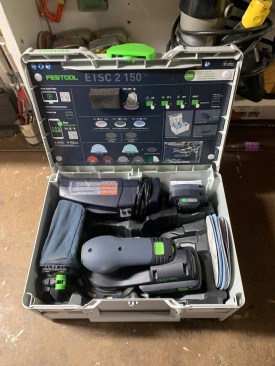
In addition to the sander, the kit included a TCL 6 charger, two 18-volt, 4.0-amp/hr, Bluetooth-enabled batteries, dust bag, plastic pad protector, 5mm Allen wrench, and a bit of sandpaper (see photo, below). For testing purposes, Festool sent along its Granat D150 starter set of six 10-packs of grit sizes ranging from P60 to P320.
Tom O'Brien
The ETSC 2 150 cordless sander kit comes in Festool’s Systainer SYS3 M box.
Positive Vibes
As I was unpacking the kit, several impressive features leaped out at me. What struck me first was how light and well-balanced the machine felt in my hand. The 4-Ah battery provided a perfect counterweight to the business end of the tool. And when I turned it on, I was surprised by the lack of vibration.
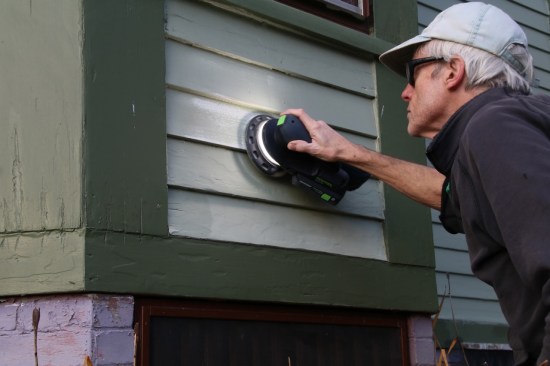
If one feature stood out—truly deserving the cliched title “Game-Changer”—it would be the LED ring light (see photo below). Unlike the tiny spots that most cordless tools feature nowadays, this one is a flood. I fell in love with it while I was scrambling to finish an exterior paint prep job before nightfall, only to discover with the push of a button that nothing could stop me now. That wasn’t even the best part; when I turned the sander loose on shop work, the shallow angle of light served to highlight the slightest swirl mark or imperfection. No longer would I have to reach for a flashlight to make sure I didn’t miss anything.
At full power, this light was blindingly bright. By pushing the on/off switch twice, I was able to cut the intensity in half. Once I became familiar with Festool’s smartphone app, I discovered that I could control a large number of options—including the length of time the light remains on after the tool shuts off—using the touchscreen.
As someone who has frequently complained (in print) about Festool’s skimpy paper operating instructions, I was delighted to find a wealth of information on how to operate and maintain this tool readily available on the app and in an easy-to-follow visual format. The video tutorial on how to pair the batteries with a dust extractor via Bluetooth was especially helpful (users who exclusively work outdoors or on new construction might never have to worry about being tethered to an extractor).
Little or No Dust
Tom O'Brien
The author found the built-in light a stand-out feature. Note the removable edge guard.
In terms of dust collection, the sander impressed me with two significant innovations. Most obvious was the dust bag, which proved surprisingly effective at preventing most debris from becoming airborne. Thanks to its quick-release connector, it never popped off during operation (unlike every other bag I’ve ever used). If not for the ring light’s ability to highlight the thin but consistent plume wafting out around the edges of the spinning pad, I might have been tempted to forgo the dust extractor altogether.
When I needed to work completely dust-free, it was easy to connect a suction hose to the sander. That was thanks to the newly designed sculpted metal dust port that accepts a D27 hose like a plug in a socket and holds onto it just as securely. Even when tethered to a dust extractor, the tool was significantly easier to operate without the added weight and hassle of an electric cord.
Battery
With the battery, the ETSC 2 150 weighed 4 pounds 8 ounces, about ½ pound heavier than the corded Festool 150/3 EQ that’s been my go-to finisher for almost 20 years. After just a few side-by-side comparison tests on rough hardwoods and softwoods, it was apparent that this cordless sander could hold its own and was ready for full-time professional use. The most noticeable difference was how much less vibration the cordless sander produced. Due to its low center of gravity, perfect balance, and the fact that it didn’t make my hands buzz, the ETSC 2 150 proved less tiresome to use for extended periods (despite the weight penalty).
I often had to swap batteries during big finishing jobs but never ran out of power. I was able to get at least 30 minutes of continuous runtime on a full charge and recharge a dead battery to 90% in roughly the same amount of time. So, two batteries ought to be enough for most applications.
I found the Festool ETSC 2 150 4,0 I-Plus 6-Inch 18V Cordless Orbital Sander Kit online for $705. The bare tool costs about $530. festoolusa.com
Keep the conversation going—sign up to our newsletter for exclusive content and updates. Sign up for free