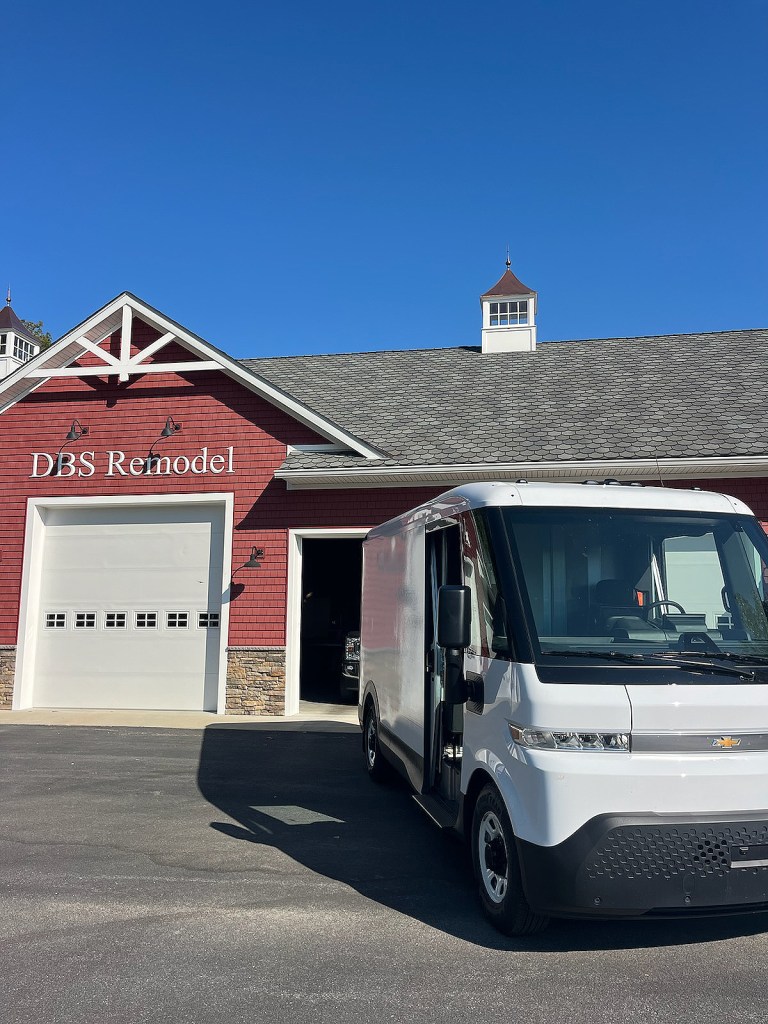
Earlier this fall, I did an “in-truck review” of a BrightDrop 400 all-wheel-drive electric work van. GM dropped off the new vehicle at my company’s shop, and we had a week to drive it to and from jobsites and use it as we would any work vehicle. We couldn’t build out the van’s cargo area to hold our tools, but we were still able to get a good idea of how the van would perform under working conditions.
Context. I’m a lead carpenter for DBS Remodel based in Poughkeepsie, N.Y. Each year, the company does about $7 million in revenue on around 75 remodels in the $15,000 to $500,000 range. We typically work on six to eight jobs at a time. The other five lead carpenters and I own our own trucks, and we each have a company job trailer outfitted with the tools and hardware that we’re likely to use on jobs.
Just before GM approached us to review the BrightDrop van, DBS Remodel ordered a new gas-powered Ford Transit. We plan to use it for small service jobs and to attend to punch-list items near the end of jobs, after we have pulled our work trailers off site but still have a few lingering finishes to install. While we haven’t used the Transit yet, the purchase speaks to our company’s need for such a van. The BrightDrop might be an alternative, although we hadn’t previously considered an electric vehicle (EV).
EV Skeptic
As interested as I was in testing out a brand-new work truck, I was initially taken aback by its being an EV. I had no experience with EVs and never considered owning one. Clearly, the truck industry is headed in the EV direction, but I was not in the market for a new truck and have never been an early adopter of new tech.
The first electric pickup I knew about was the Rivian, billed as a “luxury” vehicle, which (along with an unrealistically high price tag) didn’t present itself as a serious work truck. Ditto for Tesla’s Cybertruck. The electric Ford Lightning, which went into production in 2022, and the first electric Ford Transit, which was produced about a year earlier, were the first electric work vehicles that I found credible.
Companion Articles
For me, the electric vehicle category seemed to have too many question marks: Driving range? Battery life? Charging times? The resilience of the nation’s power grid? If I thought about EVs at all, I reasoned all of the above would have to evolve before I considered an EV a work option. So, when I sat behind the wheel of the new BrightDrop, I was skeptical, to say the least. But it took me about eight seconds to be pleasantly surprised and only a few minutes more to become thoroughly impressed.
Under the Hood
My first reaction to driving the BrightDrop was realizing how powerful it is. It feels different from a truck with a big V8 internal-combustion engine (ICE). For starters, it’s super-quiet and incredibly smooth. All I felt was acceleration, and I heard none of the higher pitch and increased noise volume that accompanies stepping on the gas of an ICE. (As much as I love the growl of a big gas engine, it’s not a feature we look for in work trucks operating in quiet residential neighborhoods, particularly when we want to start work early in the summer.)
I also didn’t hear or feel the downshift when I was bearing down on the gas pedal to power up a hill. Instead, I had the sensation of stepping on the drive pedal and feeling a quiet surge of smooth, continuous power. Going uphill with a load of lumber, I never bottomed out on the drive pedal; there was more than enough power there if I’d needed it.
The two electric motors on the all-wheel-drive model we tested reportedly deliver 300 horsepower, which is less than any V6 in current models of light-duty ICE trucks. But horsepower is not the best measure here.
Unlike an ICE truck, an EV delivers instant torque, which gives the BrightDrop powerful, immediate acceleration from a complete stop. This is ideal for stop-and-go city driving and for getting heavy loads moving. Horsepower is a better measure of a vehicle’s sustained power at higher speeds, which you need for towing. The BrightDrop is not designed for either towing or off-roading but, for hauling, it holds its own.
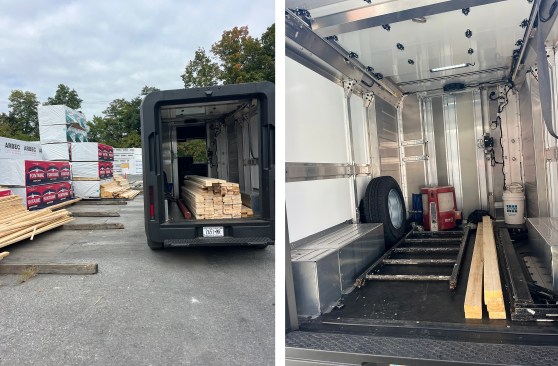
For the building trades, the two critical features of the BrightDrop 400 van are its payload capacity of 3,480 pounds and excellent maneuverability. Cargo-area height with the door open measures 76 inches; floor length is 117.5 inches; and the width between the wheel wells is 54.71 inches, 83.68 inches wall to wall. There are ample tie-downs and rails for mounting custom toolboxes and shelving.
At 3,480 pounds, the payload capacity of the AWD BrightDrop 400 exceeds the 3,325-pound capacity of the 2025 Ford F-150—the leader among 2025 Class 2A pickups. (Compare this with the payload capacities of other full-size, Class 2A pickups: 1,750 to 2,280 pounds for the Chevrolet Silverado and 2,370 pounds for the Ram 1500 with a Pentastar V6. However, with a gross vehicle weight rating of 9,900 pounds, the BrightDrop 400 fits a 2B classification. That puts it in company with the Ram 2500 and Ford F-250, which have payload capacities above 4,200 pounds.)
The most we loaded on the BrightDrop was 50 2x6x8-foot studs with another 25 2x4x8-foot studs stacked on top—about 1,000 pounds in all. Not too surprisingly, we noticed zero change in the height of the suspension with this load. We certainly had a lot more room in the cargo area, and if this were our regular work van, we would probably be carrying at least 1,500 pounds of tools and hardware in addition to any materials, but even that would leave us a healthy margin to load it up more. The added weight would use up more battery charge, just as an ICE truck will use more gas or diesel when loaded.
GM Envolve
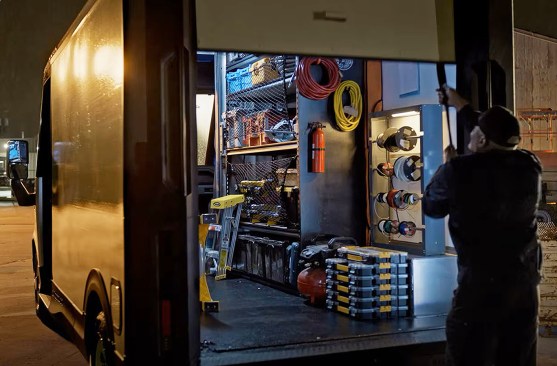
A significant benefit of a step van for the building trades is a cargo area that can be customized to organize and transport tools and equipment while leaving room to haul materials. Whalen’s week-long test didn’t provide the opportunity to realize this, but this photo from GM suggests the possibilities.
Behind the Wheel
I was especially impressed by the BrightDrop’s ability to make tight turns. As a full-service remodeling company, we usually work in residential neighborhoods with narrow streets and small driveways. The good maneuverability of the van was especially noticeable when we navigated through a lumberyard where the lanes between stacks of building materials were a bit snug.
BrightDrop’s tight turning capacity is reportedly enabled by “four-wheel steering,” which GM engineers derived from the Hummer’s “crabwalk” feature. At low speeds, the rear wheels turn in the opposite direction of the front wheels, which effectively shortens the vehicle’s turning circle and allows the vehicle to pivot more tightly than a vehicle with only front-wheel steering.
The listed turning diameter is just under 44 feet, on par with many full-size pickup tricks and quite a bit tighter than any of the 2025 full-size crew-cab pickups. This is remarkable, considering that turning diameter is usually correlated to the length of the wheelbase. The BrightDrop has a relatively long, 153-inch wheelbase, almost identical to the Ram 1500 crew cab and only a few inches shorter than the rest of the full-size crew cabs, which have only 6-foot 7-inch beds or shorter.
The long wheelbase on the BrightDrop contributes to a cargo bed that’s about 9 feet 9 inches long. With the door open between the cabin and the cargo area, you get an additional 2 feet or so of floor space, making it possible to slide in 10-footers or even a few 12-footers (though the cabin floor area in line with the cargo-area door is limited by the pedestal landing that the driver’s seat is mounted on). The BrightDrop is considerably easier to load, too, since you can shut the rear door on long lengths of lumber and don’t have to worry about flagging material that sticks out the back.

The BrightDrop’s huge windshield erases any forward blind spots, and the enormous shelf area behind the dash is unusual but opens up many possibilities for organizing a tradesperson’s daily carry.
Camera visuals. The driving experience, and sense of security while hauling materials down a highway or through a busy residential neighborhood, is greatly enhanced by the van’s visual supports. A button on the large dashboard screen toggles camera views all around the van. The driver can see virtually anywhere along the sides and at the back of the van. The computer even stitches together a bird’s-eye view of the van and its surroundings, so you can see children, bikes, basketballs, and all the other things in a customer’s driveway no one wants to run over. The camera views can be accessed anytime while you are driving the van.
Battery Charging
By far, the biggest adjustment for me was learning about the battery and charging it. Note that our tests weren’t perfect: We didn’t have another EV for comparison, and we couldn’t fully load the truck with tools, which would have reduced the driving range on a charged battery. Over the week, we only had to charge the van twice. This was straightforward: Plugging in the charge cord is not much different from filling up at a gas pump, except for a green indicator light near the charging port that turns on when charging is complete. To stop charging before that happens, I simply had to press “stop” on the charging station or on the vehicle’s dashboard screen.
If we owned an EV, we would install a charger at our shop, so we could charge it overnight and wouldn’t have to waste production hours charging it during the day. With the max-range battery on the model we tested, it took about an hour to add 160 miles of range at a DC fast-charging station. (Reportedly, it takes about 10 hours with a Level 2 charger for a full charge, and about two hours with a DC fast charger.)
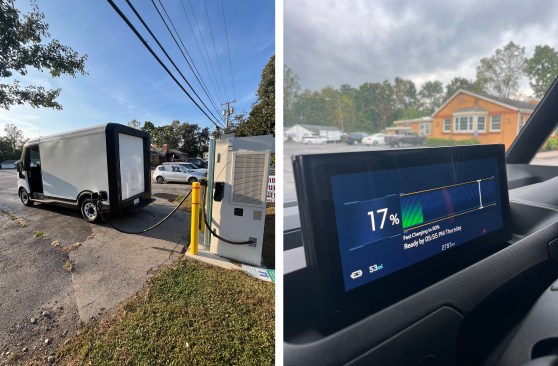
Charging at a DC fast charger is not much different from filling up at a gas station, except it takes longer. To maintain battery health, GM sets the maximum charge to 80%; it also recommends charging the battery when its capacity decreases to about 20%.
You’ll get better driving range if you don’t stomp on the drive pedal but instead accelerate gradually and evenly. It’s also better for battery health to avoid frequent DC fast charges. And like with phones or other devices powered by a lithium-ion battery, it’s best to charge to about 80%. (Cordless tool chargers do not allow this; power tool companies are in the business of selling us batteries.) The default on the BrightDrop limits the charge to 80% (160-mile range), though you can override this to get 100% charge if you need the full range (272 miles) for a longer trip. For optimal battery health, GM recommends keeping the vehicle plugged in when parked, especially in extreme temperatures. This allows the van to use an external power source to regulate the battery’s temperature.
Cabin and Seating
The BrightDrop was initially built as a delivery truck so it includes features designed to shave minutes off “last mile” deliveries. For example, with the “delivery mode” engaged, shifting into park turns on the cabin lights, honks the horn once to alert people nearby, and unlocks the cabin and rear cargo doors—not a feature building tradespeople will ever want or use.
Instead of the van’s six-way adjustable bucket seat for the driver plus the small, not-too-comfortable jump seat that folds down off the back of the cabin wall, we would prefer a bench seat that could accommodate a couple of carpenters, even though that configuration would block the door into the cargo area from the cabin. The trade-off would make sense for our profession, especially if the bench seat could be designed to fold out of the way to allow occasional access to the cargo area (and we’d want to be able to slide long lumber under the seat). The lack of a bench-seat option was the one aspect of the BrightDrop that we didn’t like and that would motivate us to look at other vans.
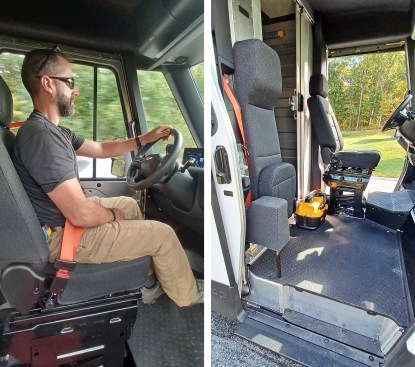
The driver’s six-way-adjustable bucket seat (above left) is comfortable, but the fold-away jump seat (above right, in foreground) is not. For the trades, a bench seat that can seat three would be more functional.
Touchscreen. The BrightDrop’s centrally located touchscreen on the dashboard (GM calls it an “infotainment screen”) is powered by Android Automotive with “Google Built-in” providing access to Maps (and other apps available from the Play store). The menu’s simple grid structure is easy to navigate. The main application we’d use would be Maps, and if it were our vehicle, it would be nice to customize it to compare the miles to jobs against the van’s driving range. Beyond this and access to charging and range data and the camera views, our company’s chief concerns are the power, maneuverability, and overall ruggedness of the vehicle, not its entertainment system.
Midsize seems right. GM makes a larger EV van, the BrightDrop 600, with a longer cargo bed and more volume (614 cubic feet of cargo area compared with the 400’s 412 cubic feet). While it’s cool to think of the on-site-shop possibilities with the larger van, we’d stick with the midsize 400 to realize its exceptional maneuverability. For our business, the 400 would perfectly fit our needs if it had a different seating configuration.
What’s Coming
If you go out to buy a new BrightDrop today, you’ll be looking at 2026 models. Several improvements scheduled for the new model year seem appealing: The payload increases to 3,710 pounds; the cargo-area roof is reinforced so you can add a ladder rack there; and built-in 120V and 240V outlets that can deliver up to 7.2 kw split-phase AC power in the cargo area are standard. All are features that make perfect sense for the building trades.