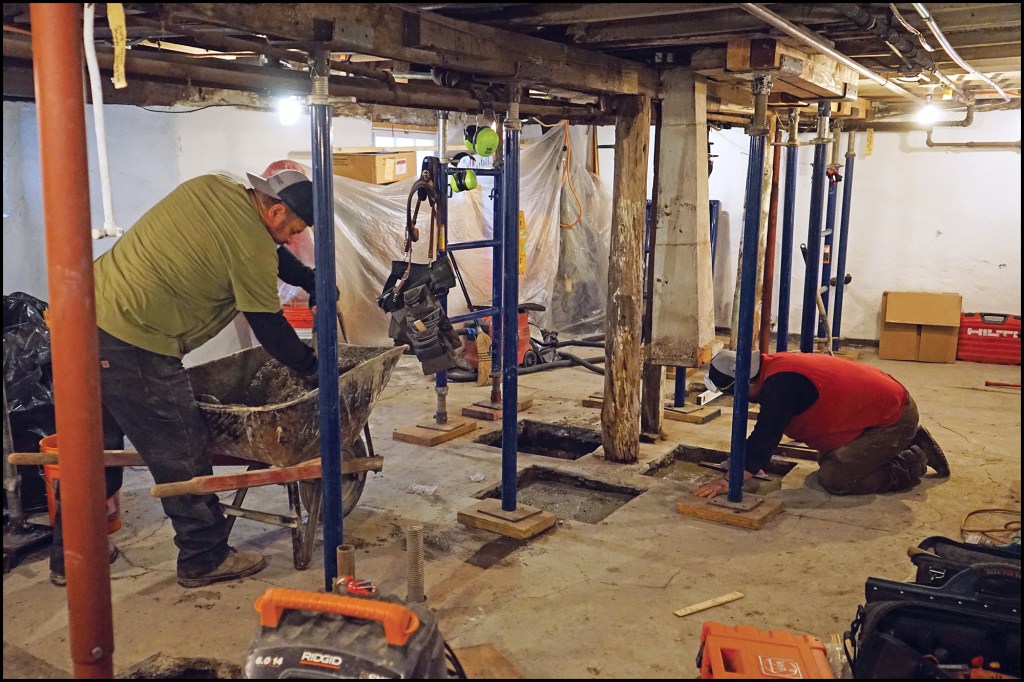
One of the most common structural repairs our company, Great Lakes Builders, is asked to complete is the replacement of a basement’s center girder. We’re based in Chicago, and in this part of the country, people commonly refer to this girder as the “beam line.” Here, as in other parts of the country where basements are common, the first-floor floor joists break over the girder running down the center of the basement, and it’s common to have bearing walls over this beam, as well, so it is supporting both the first and second floors. In older homes, this critical structural support is often in a poor and failing condition.
The causes for failure are many. Often, the posts supporting the beam were built on inadequate footings—sometimes just large, flat stones, or brick and mortar that eventually deteriorated in the soil. Older homes often had dirt floors and elevated moisture levels that wicked into the posts, leading to rot of the post bottoms and settling of the beam. Termite infestation of these center girders and their support posts is also common in many parts of the country.
Almost always, the beams are undersized for the current loads. In our work in high-end vintage homes, we usually see alterations at some stage of the building’s life: A new $100,000 kitchen, a living-room floor that was leveled 20 years ago, and a master bath put in with exotic tile are a few examples. Often, the alterations add significant loads, but the challenge is not always purely structural; you also need to understand the expectations of the client. Some clients think a wavy floor adds character, but others are terrified of the plaster cracking or of tile breaking. We need to know we can meet, or even exceed, client expectations before signing a contract.
In the beam-line replacement covered in this article, the 100-year-old center beam not only supported first- and second-floor loads but also supported a chimney, which added an intense point load. A cluster of posts had been added at the midspan for support, but these proved insufficient over time for the underbuilt structure. To remediate these conditions, we followed an engineer’s design to replace the wood beam with three wide-flange steel beams, each 8 to 9 feet long, for a total beam length of about 25 1/2 feet. We added two more beams, each about 4 feet long, on each side of the center beam to help carry the chimney load. All these beam sections were supported on 3-inch, schedule-40 columns with 8x8x1/2-inch base plates bolted into new 2x2x1-foot concrete footings. The photos hit the high points of how we did it.
Read the whole article in our sister publication, The Journal of Light Construction.