
Q. During wildfires, burning material travels in the air long distances and starts fires along the way. For a home I am building in a forested area, how do I prevent hot embers from being drawn into the attic through the soffit and eaves?
A. John Chamberlin, a Wildland-Urban Interface (WUI) expert from Georgia-Pacific, responds: I’d like to approach this more like an overall strategy than a solution to just one part. Because of population growth, the density of construction, and the locations of underdeveloped space, we are frequently building in WUIs. These are vegetated areas with things that can burn where homes are being built with materials that will burn. As we do not want to simply clear-cut these areas, we need to look at accommodation. That is why we have the International Wildland-Urban Interface Code (IWUIC).
A model code like the International Residential Code (IRC), the IWUIC helps guide fire hardening for construction. In the U.S., I believe, 26 states have incorporated into their building codes some degree of fire hardening. Depending on the type of the building, its location, and the climate in that area, specific steps can be taken to reduce the overall risk of fire. I would advise taking a whole-home approach to fire hardening, instead of just focusing on one part like your question does (which I will get to). A good resource, along with local codes, is the Insurance Institute for Business & Home Safety (ibhs.org). It has a “Wildfire Ready” program for hardening homes against extreme fire events.
Tim Healey
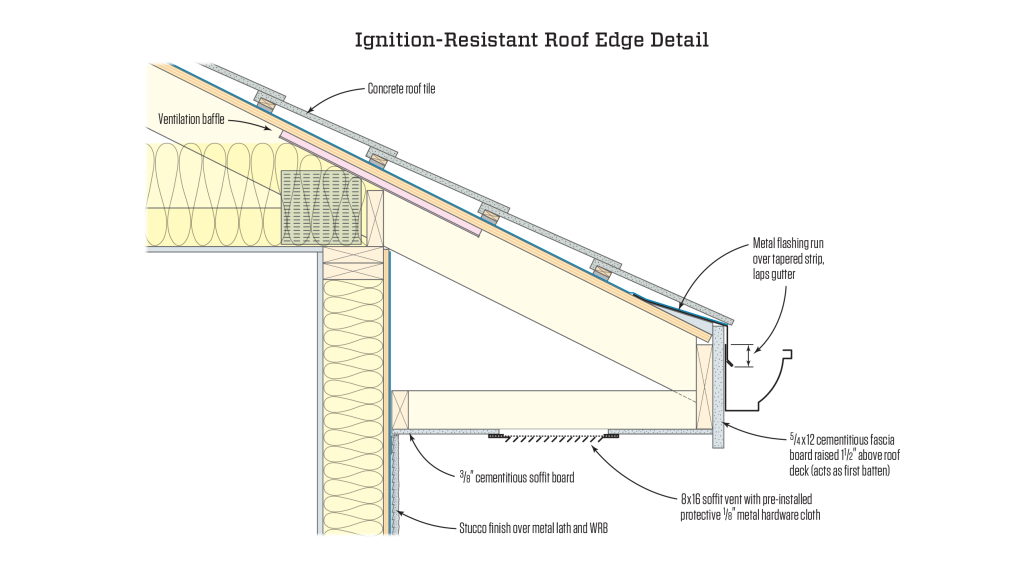
Section 504.10 of the IWUIC states that mesh openings should not exceed 1⁄8 inch, as shown in the illustration above. The author recommends 1⁄16-inch mesh. Check with your local building code for what applies in your area.
Getting back to the question, the hot air carrying the embers is going to try to find cooler air, and high pressure is going to try to find low pressure. So, the outside air will try to push its way into the house’s vents. The solution is install a noncombustible, noncorrosive metal mesh on the inside of the vents. The mesh acts as backup for the vent to catch the embers and prevent them from entering the home. Requirements for mesh size vary by state and even locality. The international code requires ¼- to ⅛-inch mesh, but I recommend ⅟₁₆ inch, which is what the California building code calls for.
While installing mesh would help prevent the embers from entering the attic space, the builder should look at the rest of the home too. If the accepted 5-foot perimeter around the home is not clear of combustible material, like mulch, or if the siding and roof are not fire resistant, the mesh will be of little use.
Keep the conversation going—sign up to our newsletter for exclusive content and updates. Sign up for free