
In this recent Energy Vanguard article, Allison Bailes analyzes what happens to the actual R-value of blown or sprayed attic insulation when the thickness of the insulation is less than uniform. In his theoretical examples, when installers put the right amount of insulation in the attic, but vary the distribution so that half of the attic gets more than specced and half gets less than specced, the insulation’s R-value can vary from the target R-value by as much as 25%. Another scenario he examines is when the installers haven’t predetermined how much insulation material they’re going to install, getting the correct amount over part of the attic and shorting the other part.
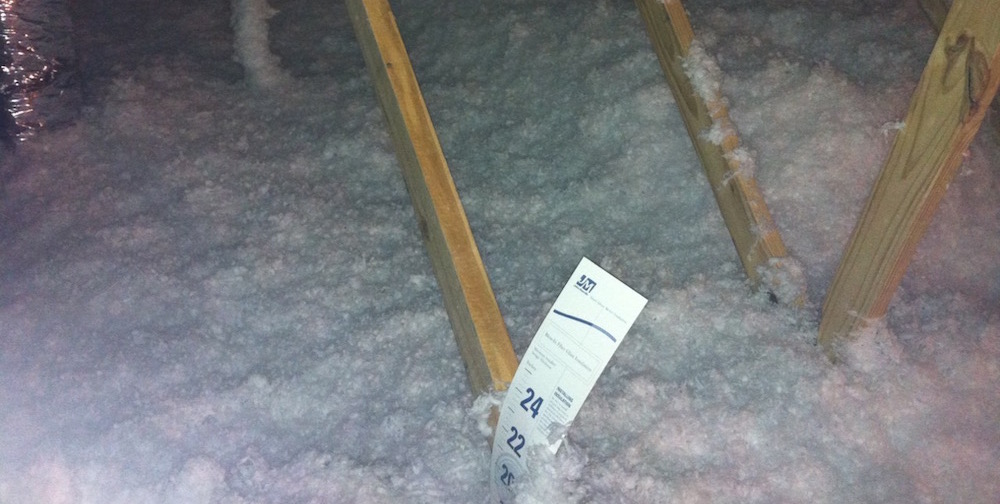
Understanding the tolerance of blown or sprayed insulation can help you get the insulation R-value you pay for. Insulation contractors usually specify the average thickness of insulation you’ll get. As you can see from the analysis here, average thickness isn’t good enough. A better way to ensure you get what you’re paying for is to specify the average thickness of insulation as well as a minimum thickness. The tool that determines that for blown insulation is the depth marker. Make sure your contractor puts in a lot of them. It’s easy for installers to pile it up to the required depth at the markers and install less between the markers. With more markers in the attic, it’s easier to see problems. With spray foam insulation, the tool is a depth gauge.