When we joined the project team for this custom home, design was nearly wrapped and no one had performed any soil testing. In other words, the house was happening regardless of what we found underground. A couple of exploratory holes were dug before our contract, but all they revealed was that excavation was going to be an expensive line item.
Excavation
The house itself is a 3,700-square-foot slab on grade with a compact 150-square-foot basement space 9 feet deep that holds the mechanical systems and the lower section of a perpetual spa pool. The grade change across the footprint of the house is roughly 4 feet. At the garage, you walk in at natural grade, but at the far corner of the basement, the floor sits 4 feet above grade. That required a 6-foot cut. Normally, this is simple work for a good operator with a solid machine, one or two days, tops. But what should have been simple took multiple weeks and required more than one machine to keep things moving.
Roughly a foot below grade, the soils gave way to rock the size of a bowling ball. Not occasional rock, continuous rock. The excavation budget went up, the disposal budget went up, and the backfill plan had to be rewritten. The rocky conditions caused frequent collapses, which forced a much wider overdig than usual. We already dig wider than most builders in our area because we want working room for our team to feel safe to execute top-quality work. On this site, we were sloping far beyond even the OSHA expectations for Type C soils, simply to keep the sides of the excavation (rolling hills, really) standing.
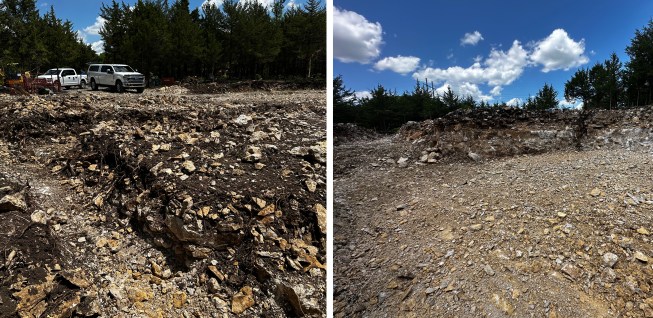
What should have been a one-day excavation with a minor 6-foot cut turned into several grueling weeks of work because of an excessive number of rocks on the site. Excavation, disposal, and backfilling all took more time and budget than expected.
Once excavation was finally complete, the question became how to backfill without blowing the budget or the schedule. We had a large pit, almost no usable material on site, and limited room to maneuver. Traditional backfill with clean material and compacted lifts was possible but would have meant a slow, equipment-heavy operation in a space that did not want to cooperate.
Flowable Fill Option
Flowable fill came up as an option. Controlled low strength material (CLSM) is essentially a cementitious backfill that behaves like water when placed and then hardens to a low-strength material. The American Concrete Institute (ACI) standard 229R 18 caps its compressive strength at 1,200 pounds per square inch (psi) to ensure it can be removed in the future if needed. (To me, psi is a misleading number. Porcelain tiles have upward of 20,000-psi ratings for compressive strength. EPS Type-IV foam is 20 psi. That same foam has a carrying capacity of 2,880 psf. Numbers get big fast, and our residential buildings are fairly light.)
It’s important to note that the same standard doesn’t set a low-side requirement for psi, so it can be spec’d very weak if needed. For this project, it made sense to combine CLSM with conventional compacted fill and take advantage of the strengths of each system.
Revised Backfill Plan
The goal was to get back to a workable elevation quickly without overspending on CLSM. We decided to place flowable fill only up to the level of the original undisturbed soil. This reduced the amount of CLSM required and brought our surface to a point where we could comfortably run a skid loader and compactor across the entire area. It gave us the result we needed while keeping the budget pointed in the right direction. It also meant we avoided burying any plumbing lines in the CLSM aside from a very short section of waste pipe at the foundation exit. Even at this elevation, we spent thousands of dollars on the CLSM.
The advantage of flowable fill is speed. CLSM comes out of the hose like a wet slurry, finds every void, levels itself, and requires essentially no manipulation. Our dozen-plus yards were placed in less than 45 minutes with one pump truck and one crew member. For any cementitious process, that is an incredibly efficient use of time and labor.
We braced the foundation walls prior to placement. With interior fill elevations higher than some of the exterior conditions and with the energetic nature of CLSM placement, bracing felt like the prudent choice. The walls did not move, the bracing came off easily, and everything performed as expected. We most likely would have executed this bracing with traditional fill as well.
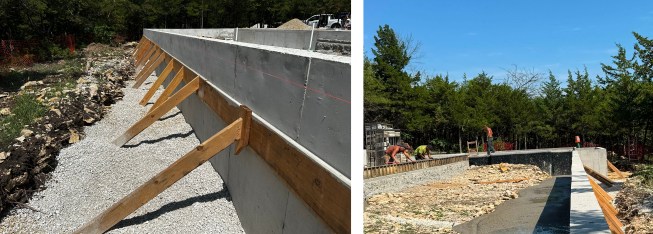
Before the flowable fill, also known as controlled low strength material (CLSM), was placed, the author braced the foundation walls (left). Because flowable fill is expensive, the author used it sparingly to fill the enlarged excavations around the foundation (right).
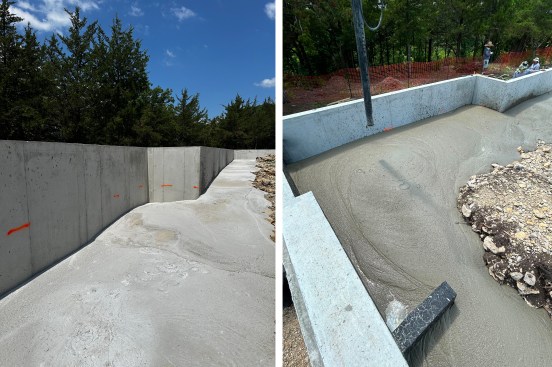
A big advantage of flowable fill is speed. It comes out of the hose like a wet slurry, finds every void, levels itself, and requires essentially no manipulation.
A few takeaways are worth keeping in mind for anyone considering using CLSM. It does not need reinforcing. It is not a structural element. It is simply backfill made up of cementitious material. Also, a pump truck is not always required. Access dictated that choice for us, but these mixes can arrive in standard concrete trucks and can even be delivered in dump trucks, depending on the proximity to the plant.
Finally, while ACI does not directly address plumbing embedment, I would avoid burying lines in CLSM unless it’s necessary. It is low strength, but it still locks things in place a lot more than compacted soil does.
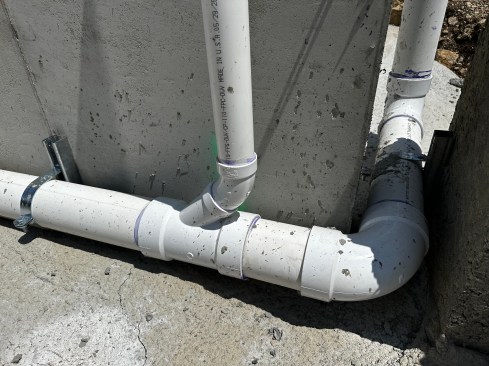
The American Concrete Institute does not directly address plumbing embedment. Playing it safe, the author kept all plumbing and perimeter drainage above the flowable fill.
This was our first time using flowable fill. Everything went as planned. Performance so far is right in line with traditional backfill materials, and we gained days or even weeks in the schedule. Will we use it again? If the site conditions are right, absolutely. But those site conditions will need to be right because it isn’t cheap.
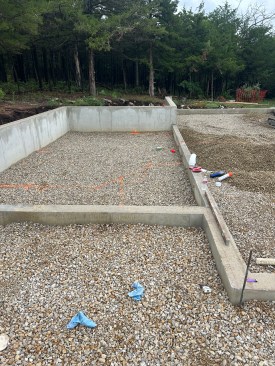
Conventional crushed stone was used for the remainder of the foundation fill.