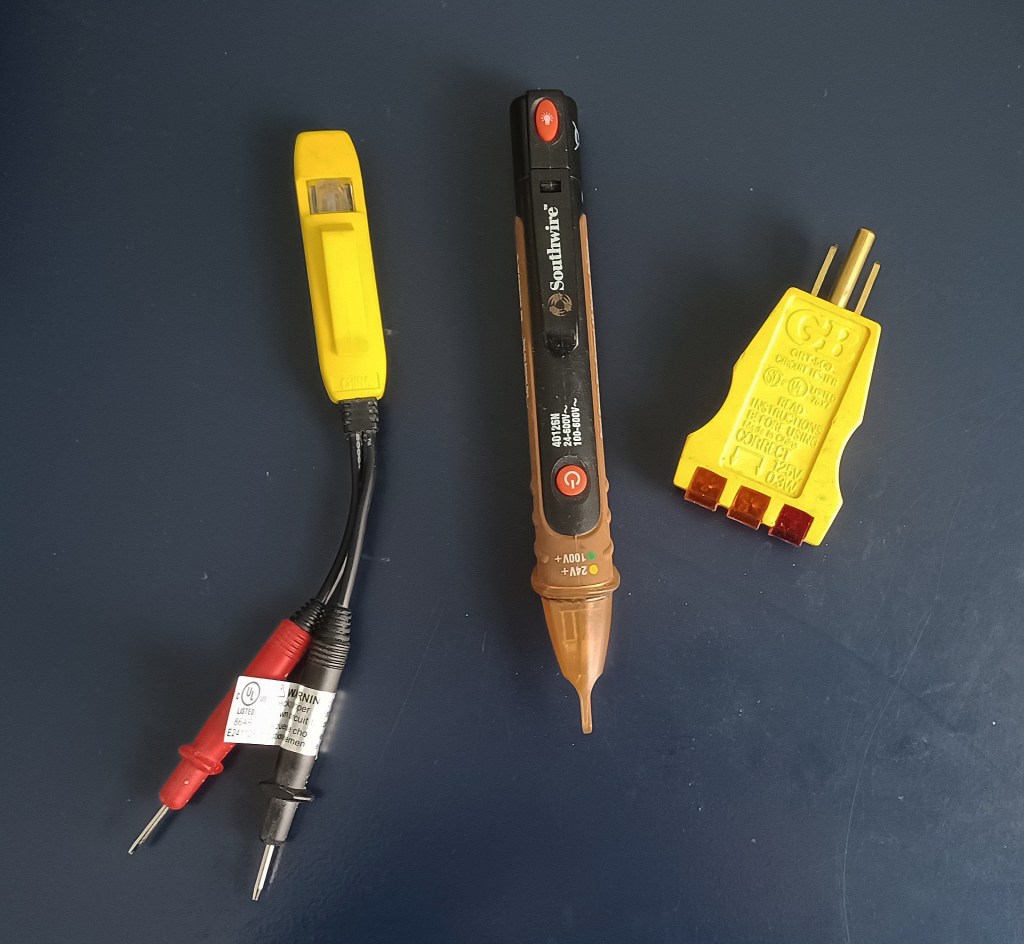
Q: What’s a safe way we can test to see if wires we find in walls during demolition are hot?
A: Chief Editor Clayton DeKorne responds: I have always relied on a simple two-wire circuit tester like the one on the left in photo above. You need to place the leads on bare wires (both hot and neutral legs); when a line is energized, the small bulb lights up. These are foolproof if you have good contact on bare wires.
But I also always carry in my bags a non-contact voltage tester like the Southwire 40126N in the center of the photo above because it’s fast, and you don’t need a bare wire. (Often during demolition, you simply have a cable running through a framing bay with no end in sight.) The end of the voltage tester lights up green but turns red and chirps loudly when placed against the jacket of a hot wire. It’s a fast check, but you should be very careful with these and still proceed with caution if you have a green light and think the wire is dead.
Some electricians call these non-contact testers “widowmakers” because you can get a false positive if the battery is low, the wire has extra-thick shielding, or conditions are wet. Even improper grounding can give a false positive, meaning the light will stay green even when the wire is hot. I always stick it in a known hot outlet or against a known hot wire of the same type to make sure it’s working as intended. And even then, I don’t assume it’s correct until I can find an uninsulated end and test for certain with my two-wire tester.
I also carry a plug-in tester like the yellow one on the right in the photo above. These work only on outlets, but they’re fast and sure and a terrific way to quality-check grounding conditions on new or existing outlets.
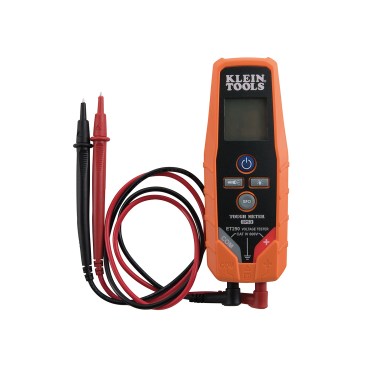
The tricky part of discovering wires during demolition is chasing down the circuit they’re on so you can turn it off at the panel. Most of the time, I do this by trial and error via cellphone with another person turning off each circuit at the panel. Or you can test for continuity with a multimeter (and some long leads connected to the multimeter’s leads with alligator clips). Travis Brungardt, a custom builder and remodeler who is also a licensed electrician, recommends using a two-button multimeter like the Klein ET-250 shown in the photo at left. It functions as a voltage detector or a continuity tester but is vastly simplified compared with models with a dial.