
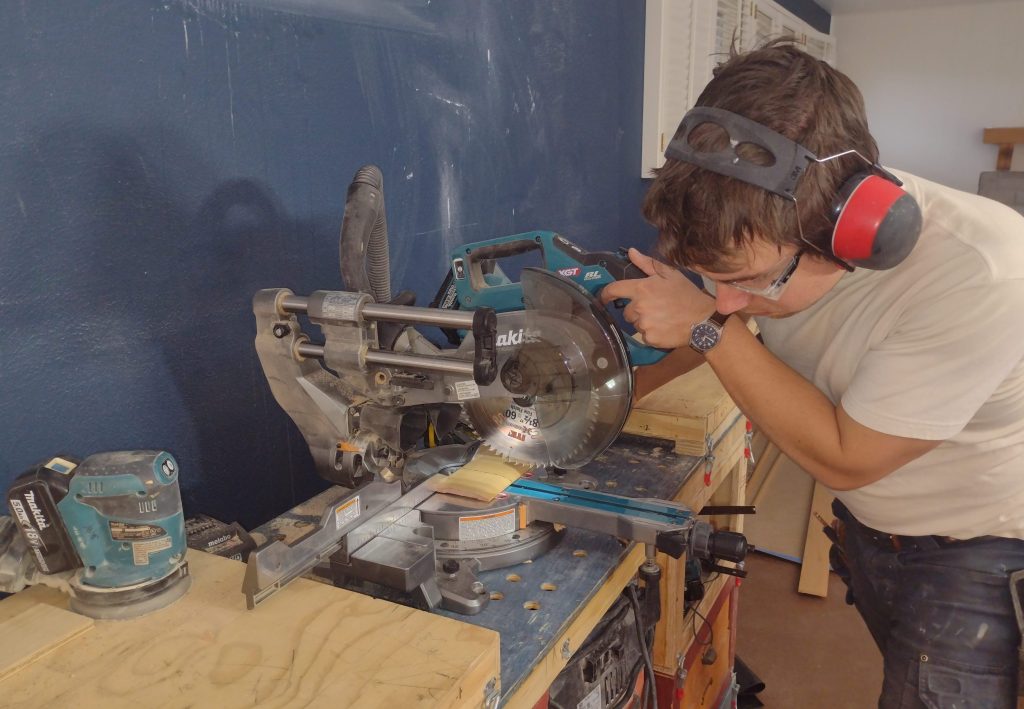
Smaller, more compact battery-powered miter saws have become quite popular over the last few years, offering greater portability than their beefier siblings while delivering most of the benefits. I’m generally a fan of smaller, more portable tools but I wanted a miter saw with greater capabilities and precision than most of the smaller 7 ¼-inch saws had to offer. I’ve spent the last few months using Makita’s 40-volt 8 ½-inch miter saw in a broad range of settings and can confidently say this saw doesn’t just offer a more portable alternative to a larger saw, but offers an array of features and capabilities that enables it to function as one’s primary saw.
Nathaniel Carlsen
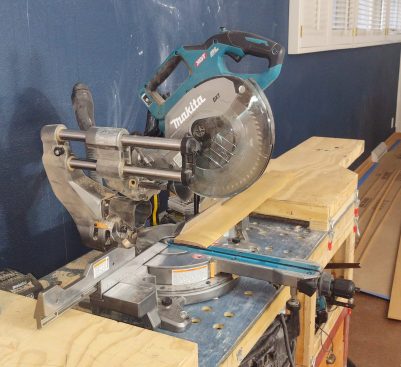
The GSL02Z has a rail-forward system so the saw can be used close to a wall. Note the multi-function front controls.
These capabilities start with the saw’s cut capacity: The saw can cut through 2 ¾ inches of material 12 ¼ inches wide at 90 degrees, with a proportionally impressive capacity when cutting a miter. The 8 ½-inch blade might seem an unusual choice, but it finds the middle ground between the 10-inch and 7 ¼-inch blade sizes, stealing the best qualities of each. When trimming, I can just barely cut 1×4 trim vertically, taking advantage of a slight divot in the saw’s frame. The combination of this vertical and horizontal capacity means I rarely wish for a larger blade. Were I to need to cut through 4×4 or nested crown, I would need a larger secondary saw. But I struggle to envision other situations this saw couldn’t handle.
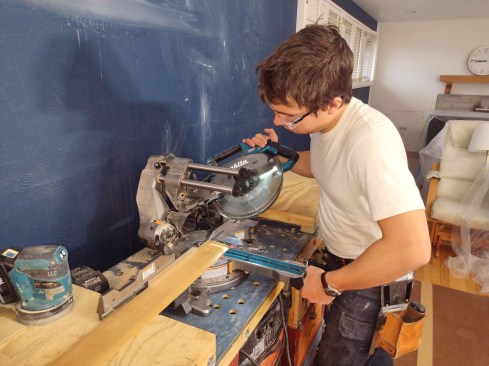
The cut capacity is only part of the capability equation because it’s complemented by a front-bevel lock. While most small-bladed saws are single-bevel the GSL02Z is dual-bevel. The bevel angles are controlled by a multi-function front-control knob. The lever for switching directions is also positioned at the front of the saw, but the lever to allow the bevel to progress beyond 45 degrees is positioned at the back of the saw. When using a smaller-bladed saw, one inevitably ends up cutting more material on the flat, which means more bevel cuts than with a larger saw. By centralizing both miter and bevel controls in one place, adjustments to the bevel can be made with ease, virtually eliminating any hassle associated with this change in process.
This saw miters to 60 degrees and bevels to 48 degrees in both directions. The smaller blade is also stiffer and less prone to deflection. I can’t sing the praises of this design enough; being able to make a quick bevel adjustment without the reach-around action that most saws have resigned themselves to is a revolution for precision work.
With the cut capacity and smooth-angled controls, Makita had already created a saw able to keep up with its much larger cousins, but they weren’t done adding features. It was a fraught decision for me to add another battery platform, but with its 40-volt battery this saw has plenty of power for whatever you throw at it, and one 40-volt battery tends to last through a full day of moderate cutting—and can be rapidly recharged over lunch. Moreover, the power delivery is smooth, enabling one to cut precisely without the saw trying to buck at the beginning or end of the cut. Dust collection is pretty good, definitely better than most miter saws I’ve used. I haven’t had the opportunity to use Makita’s bluetooth dust collection system but I imagine it would be a handy add-on. Makita also added an LED cutline to the saw, allowing for quick and easy gauging of where the cut will fall, which, in my opinion, should be a standard feature given its advantages. However, the cutline is my only gripe with the saw because it requires one to push a button to engage the light rather than turning itself on automatically. Some of my coworkers found this motion more awkward than others, but at this point I’ve gotten used to it.

Nathaniel Carlsen
The author can control miter and bevel without having to reach t…
The best part about the saw is that all these features are included in a very compact package. The saw weighs 48 ¹/₂ pounds, which isn’t light but is easily manageable when paired with the saw’s small footprint. This small footprint stems largely from the saw’s rail-forward design, allowing the saw to feel better balanced when carried. The rail forward-design is the chef’s kiss on this saw: It’s easier to move around and it can be more flexibly located than most other saws. This really shone through for me when I was using the saw to dial in the head casing on a series of doors; I tucked the Makita into the hall closet, allowing me to have my saw two steps away whilst enabling myself and a host of subcontractors to also pass through the space. When space is at a premium, those last few inches of clearance are a big advantage. The combination of a small size and a large cut capacity means that the saw is well-suited to standing alone when working on smaller parts, or set up as a full cut station.
All these features do come at a hefty price tag—the Makita currently retails for $850 bare tool (GSL02Z) or $1100 (GSL02M1) as a kit. This was a hard price to pay but the capabilities of the saw make it well worth it. The small size and wide array of features means I end up using my miter saw more, encouraging a safer, cleaner, and more precise job site. Whereas I might have previously eschewed a miter saw in favor of a circular saw when framing, it’s now a no-brainer to set up the Makita when a touch more precision and repeatability is needed. Need to make a quick cut for a punchlist task? The Makita is there, no cord or back-breaking lift needed. But when the chips are down and the most demanding of detailed work is necessitated, the Makita is also ready to handle the work with more power, precision, and operability than many larger saws. It’s the true Goldilocks saw: Everything is just right. Find it at makitausa.com.
Keep the conversation going—sign up to our newsletter for exclusive content and updates. Sign up for free