
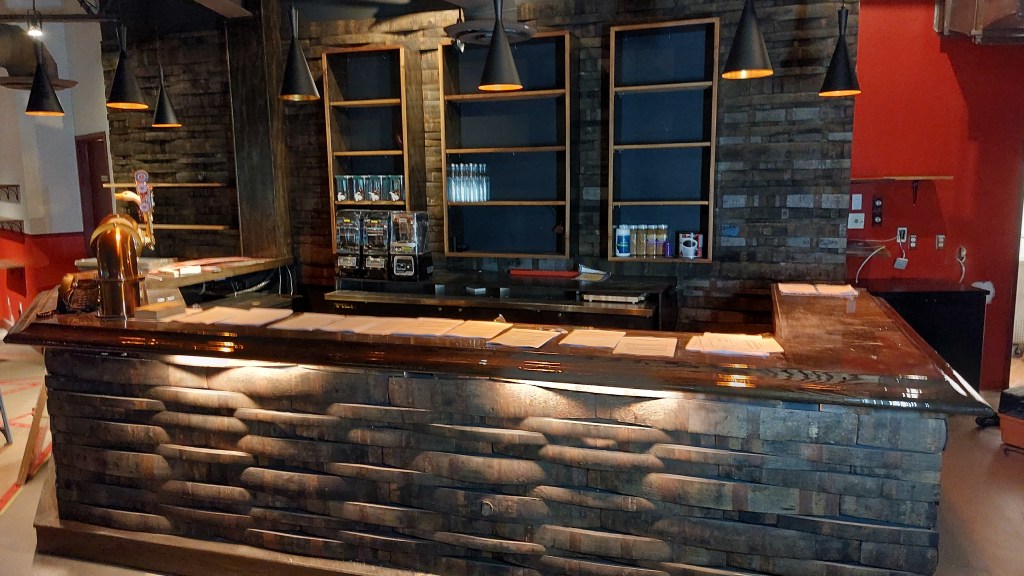
Occasionally, I build something out of the ordinary. A client may hand me a vague idea or rough sketch and ask me to make it work and look good. Or a client might want to repurpose materials into something that they were never intended for. Both applied to a project I did for friends at a restaurant they were opening.
One of the partners had another business selling small oak barrels for aging cocktails and other spirits at home (urbanbarrelcompany.com). Since he planned to sell the barrels at the restaurant, he wanted to incorporate their “spirit” into the space. So, through contacts in the distillery industry, he bought barrel staves from decommissioned whiskey, bourbon, and brandy casks for the cost of freight. He then tasked me with using these staves to cover the bar and some of the walls, leaving the details for how to go about it to me.
Marc Forget
The lighting highlights the varied texture of the barrel staves.
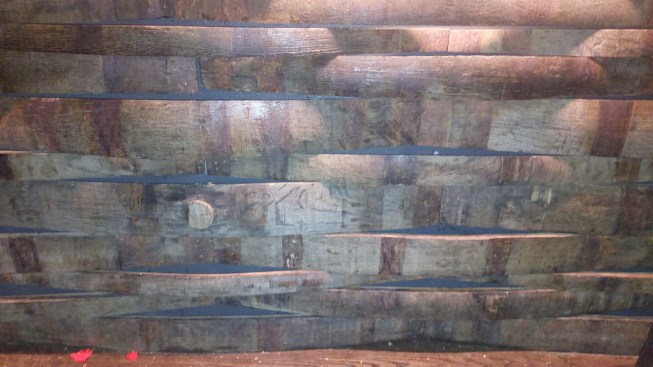
Repurposing a material always presents challenges, and using barrel staves as a cladding material is rife with them. Staves are not straight, flat, evenly sized boards. They curve (which can alter the length), taper at each end, and vary in width. In addition, they are made from well-seasoned white oak with a charred surface on one side, a very hard material that is tricky to cut and gifts you with a fine powder of soot each time you handle it.
Assembling the staves was like putting together a puzzle of randomly sized pieces without a guide. I chose a horizontal weave pattern in which the end of each stave would land in the middle of the staves above and below. I drew vertical lines at the start and stop points for a guide. Then, I sorted the staves roughly by width into five groups. For each line of the weave, I used staves from only one of these groups, leveling each stave as I installed it. Though these steps took time, they prevented lines from dipping, rising, or ending short. They also helped me minimize the size of the gaps that the curved staves formed. To soften the contrast with the surface visible through the gaps, I painted the background a dark charcoal color. This seems to enhance the 3D character of the staves.
Cutting was, as mentioned, tricky. I had to ease the blade in and use clamps to hold the material to keep the blade from binding or the stave from jumping off the saw, even with a firm grip. For the soot, I ran a vacuum on the saw and an air cleaner in the room, but that dust still spread all over me and the work area. As a plus, an aroma of campfire, aged spirits, and oak filled the room.
The finished look is unique, as well as a one-off (hopefully) for me. The owners got the bold statement they wanted to distinguish their restaurant. The cladding starts conversations, links the different parts of the enterprise, and, with its weathered oak finish, has proved to be durable. As with other difficult flights of fancy I have built, I am both proud of the result and not keen to repeat what was a painstaking process. But you never know …
Keep the conversation going—sign up to our newsletter for exclusive content and updates. Sign up for free