It would never occur to me to make a woodworking fixture out of a bowling ball. But then I’m not Marc Kunkel.
During a recent tour of Fort Houston (a community of craftspeople who share shop space in Nashville, TN) I saw something interesting and wandered away from the crowd. The next thing I knew I was in another part of the building in shop space rented by Marc Kunkel of Kunkel & Son Fine Woodworking.
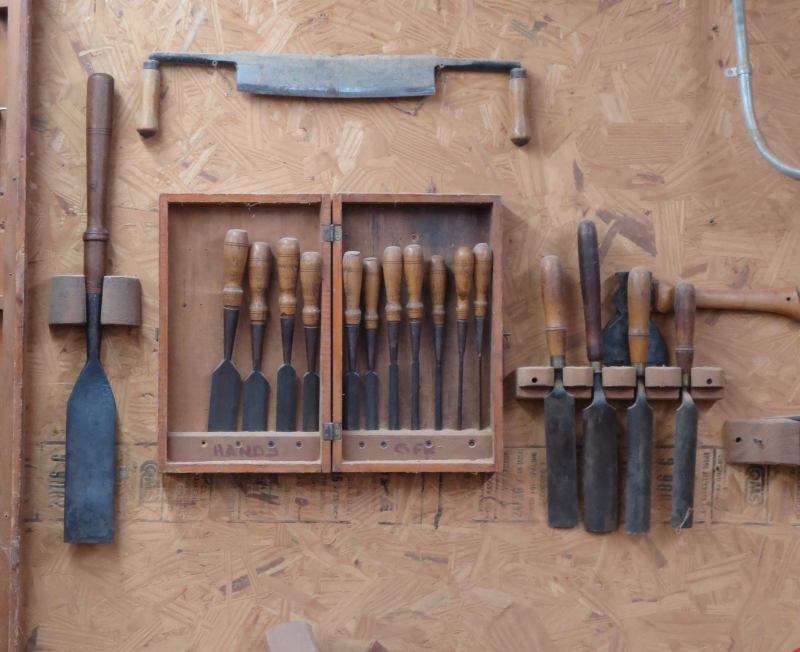
I was admiring the hand tools hanging above a bench – a draw knife, some nice old chisels, and a beautiful slick – when Kunkel came up and asked if he could help me. At that point I realized I was in his private workspace, apologized for entering uninvited and asked if it would be okay to photograph the slick, because you don’t often see ones that old in such good condition. Kunkel said it would be fine to take photos and told me the slick had come down to him from his great-grandfather, a barn builder.
I was admiring an adjustable work stand he’d made from the base of an old dentist’s chair when he said “if you like that then let me show you sometime really interesting”, and he placed a thick block of wood on the bench and plopped a bowling ball into a hole in the top of it. One of the ball’s finger holes had been drilled the rest of the way through and a plumbing pipe capped with a flat piece of wood was screwed into it. Pipe nipples with ball valves screwed into a pair of holes on the sides of the block.
Kunkel explained that the nipples could be connected by hose to a vacuum pump and when a vacuum was applied, the bowling ball became a clamp for hard-to-clamp pieces, like the curved stair rail parts he often carved. The suction keeps the ball from moving around and holds the work tight to the piece of wood on the pipe coming out of the ball. By releasing the vacuum Kunkel can remove the work piece or shift the ball to a different position.