
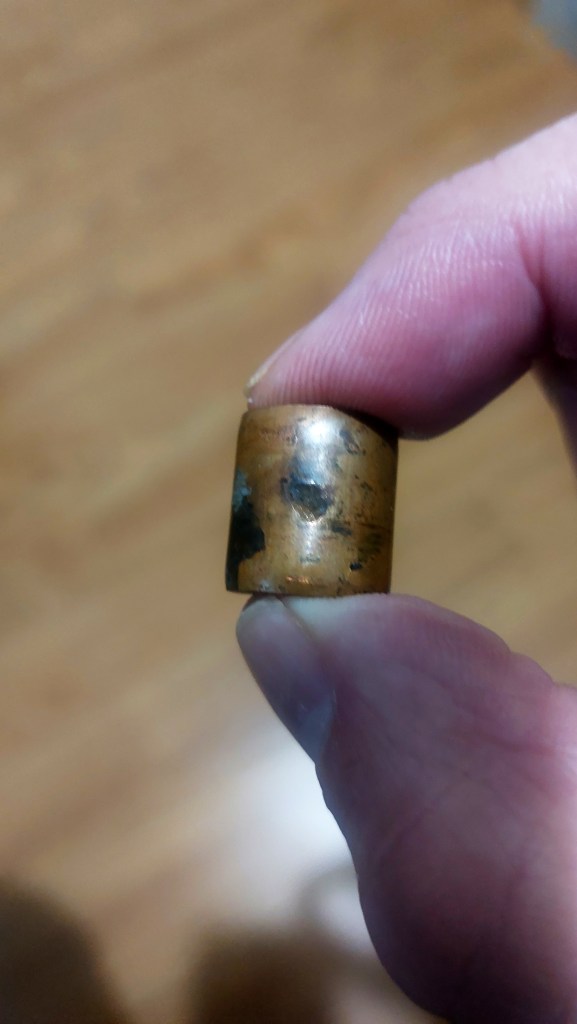
A little while ago a friend called me about a plumbing leak in her basement. The main line from the hot water tank had sprung a leak in the ceiling. Water had sprayed across the floor and onto part of one wall, luckily not for too long before she noticed it. She had already turned off the main water supply valve and was wondering if I could fix the leak or knew someone who could. I told her I would come by that afternoon with my plumbing tools and see what could be done.
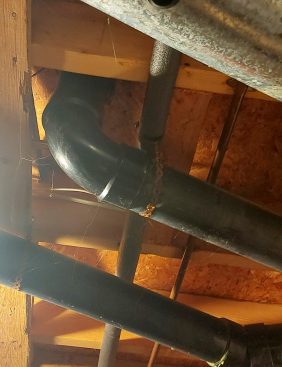
When I got there, I removed the foam pipe wrap on the hot water line where the leak was coming from and saw that a small groove had been worn in the copper pipe by the metal plumbing strapping that was supporting the ABS drainpipe. This strapping had been installed up to the framing and was just touching the copper pipe next to it. Over many years the movement of the house or pipes or both had been enough to make the water line and strapping rub one another.
Marc Forget
You can just see the strapping just touching the water line. The result was a small groove in the pipe, enough to leak.
The fix ended up being straightforward enough that even a carpenter like me could handle it. I took down the strapping, cut out the section of copper with the hole, and put in a new coupling to connect the pipe ends. Leak solved. I then installed new strapping to support the 4-inch ABS, but I made sure it was in a spot that would have no chance of touching the water line again.
A happy ending all around. The fix was easy, the affected basement area was unfinished, and the small leak was caught before any damage could be done. We can all run the film in our heads of how much worse this could have been if any of those previous factors of time, volume, or location had been different. I have no doubt that when the plumber ran the pipes and put up that strapping so close to the water line they looked at it and said, “That will be fine.” And it was—for years, until that day.
It got me thinking about all the details we address when we build anything, and how a small miss can turn into a big problem later on. I am sure all of you have a catalogue of these edge cases where an element of the build was done “okay,” but over time caused a failure. Most of the time the worker who created the detail never sees the problem.
An experienced carpenter will take extra care to prevent these problems: Like installing some extra blocking for trim or for hanging cabinets. Or taking some time to think about how wires or pipes are run to reduce the chance of being damaged by a nail, rather than running them in a way that’s most convenient. When we take that extra care we build in redundancy that is not seen but is important. It comes from thinking, “I can do it this way and it will be fine, but if I add this or do it a different way it will be better. And better will last longer.”
The point here is that a pro will stop and ask why something is done a certain way, and will search out different ways of doing the work. If you are reading this magazine, you probably already do that bit of extra. This plumbing incident reminded me that a little extra thought does make an outsized difference over the life of a house. The occupants of the house may never see those extra details, but they will see the consequences if the details are not there. So this is a reminder to keep doing the extra, looking for the better way, and thinking through the next step. The care taken may be hidden but all those little things really do matter.
Keep the conversation going—sign up to our newsletter for exclusive content and updates. Sign up for free