
When policymakers and builders talk about reducing the carbon footprint of homes, conversation typically centers on heating systems, enclosure performance, and appliances—the ongoing operational emissions generated by a building over its lifetime. But a growing awareness over the last decade has focused on “embodied carbon” —the carbon emitted in production and handling of building materials – and a major new study from Massachusetts underscores the importance of the carbon that is emitted before construction crews leave the jobsite.
A New Lens on Building Emissions
The Massachusetts 100-Home Embodied Carbon Study, released in December 2025, is the product of a multiyear collaboration between the Northeast Home Energy Rating System (NEHERS) Alliance, Stephens & Company, Ekotrope, Builders for Climate Action, and NMR Group. Funded by the Massachusetts Clean Energy Center (MassCEC), National Grid, and Eversource, it is the first study of its kind to measure both operational and embodied carbon emissions in newly constructed homes at meaningful scale, and is considered a “test-drive” for the RESNET/ICC 1550 Standard that will enable professional Home Energy Rating System (HERS) Raters to measure and report embodied carbon.
The study analyzed building construction and mechanical equipment data collected by certified Home Energy Rating System (HERS) Raters at 100 newly constructed single-family homes across Massachusetts. It produced estimates of the embodied carbon emissions (ECEs) generated during the extraction, transportation, and manufacturing of construction materials (lifecycle stages designated A1 to A3) alongside forecasts of operational carbon emissions over a 25-year period.
Related information:
Reducing Carbon in Buildings
A builder’s guide to carbon-neutral building practices
What Is Embodied Carbon—and Why Does It Matter?
Embodied carbon refers to the greenhouse gas (GHG) emissions associated with the production, construction, maintenance, and eventual disposal of building materials. Unlike operational emissions—which accumulate gradually over decades of energy use—embodied carbon emissions are largely front-loaded. They enter the atmosphere before a home is occupied, representing what the study team calls an “unrealized opportunity to capture up-front carbon reductions across all building types.”
This study focused specifically on the production stage, known as “cradle-to-gate” emissions, which covers raw material extraction, transport to factories, and manufacturing. Downstream stages in the building process, including construction (A4 to A5), maintenance (B1 to B5), and end-of-life disposal (C1 to C4) were excluded due to limited data availability and uncertainty about data quality.
“As buildings become more operationally efficient, the proportional weight of embodied carbon grows.”
As buildings become more operationally efficient, the proportional weight of embodied carbon grows. Ignoring it risks systematically undercounting the true climate cost of new home construction.
How the Study Was Conducted
Massachusetts was a natural setting for this research. An estimated 88% of newly constructed homes in the state receive a HERS rating—a figure 20% higher than any other state in the country. This high adoption rate means an experienced HERS Rater workforce is already embedded in the new construction market, collecting detailed energy modeling data for virtually every new home built.
The study team recognized that a significant portion of the data needed for embodied carbon assessments—between 60% and 70% of it, depending on the home—already exists in the energy modeling files that HERS Raters produce. The study was designed to close that gap efficiently, without requiring Raters to conduct additional site visits.
To evaluate the embodied carbon of the homes, the team developed an integration worksheet to transfer building material data from Ekotrope, which developed a RESNET-accredited energy modeling tool widely used by Massachusetts Raters, into the Building Emissions Accounting for Materials (BEAM) tool developed by Builders for Climate Action. Participating HERS Raters were trained to use the integration sheet and to collect additional information from building plans. They then used the BEAM estimator to generate embodied carbon estimates for each home. All homes followed the projected assessment pathway outlined in the RESNET draft Standard 1550—the first embodied carbon standard developed for the low-rise residential sector.
Operational carbon emissions were modeled using outputs from Ekotrope’s rating software converted to carbon using regional emissions factors from the 2024 National Renewable Energy Laboratory (NREL) Cambium dataset for the ISO New England grid – the same methodology used in the RESNET Carbon Index.
Key Findings
Embodied carbon describes a significant share of lifetime emissions
The 100 homes in the study sample produced a combined total of 5,555 net tons of CO₂ equivalent (CO₂e) in embodied carbon emissions – an average of 55.5 tons of CO₂e per home over 25 years. To put that figure in perspective: The total of the embodied emissions from this sample alone is equivalent to that of a gas-powered vehicle driving 14 million miles.
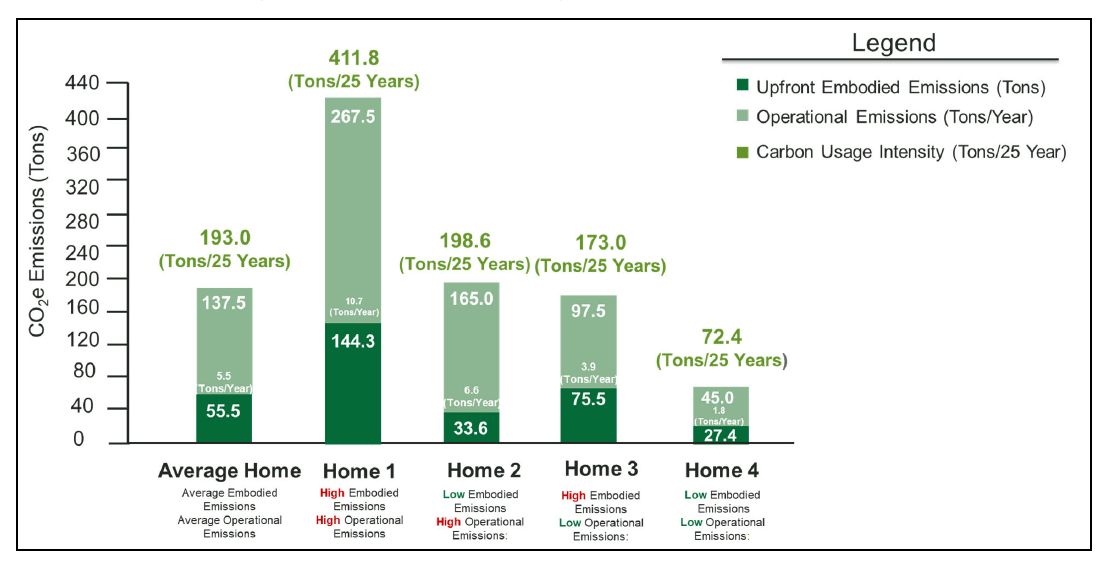
Over a 25-year horizon, embodied carbon can account for as much as 32% of a home’s overall carbon emissions. The study found that operational emissions contribute an average of 5.5 tons of CO₂e annually per home.
Extrapolating the study’s average ECE figure to Massachusetts’ broader housing market underscores the stakes. In 2024, Massachusetts built 11,390 new homes. At 55.5 tons of CO₂e per home, those homes collectively generated an estimated 632,145 tons of CO₂e in embodied carbon emissions.
Home size and type drive significant variation
The study found wide variation across individual homes. The highest-ECE home in the sample—an extremely large residence exceeding 8,400 square feet with a walkout basement, significant poured concrete, extensive open-cell spray foam insulation, and a dual-fuel heating system using both a propane furnace and an air-source heat pump—produced 144.3 tons of CO₂e. The lowest-ECE home, a compact residence under 700 square feet with minimal concrete and a single air-source heat pump for heating and cooling, registered just 18.5 tons of CO₂e.
By home type, single-family detached homes with two or more stories had the highest average net ECE at 59.2 tons of CO₂e, compared to 52.8 tons for one-story detached homes, 45 tons for duplexes, and 39 tons for townhomes. Townhomes also performed best in cumulative 25-year carbon—showing 26% lower MEP-system ECE, 32% lower building enclosure ECE, and 38% lower operational carbon than the sample averages.
Concrete, insulation and MEP materials dominate embodied emissions
Three product categories account for 68% of all gross embodied carbon emissions in sampled homes: concrete (39%), MEP systems (18%), and insulation (11%).
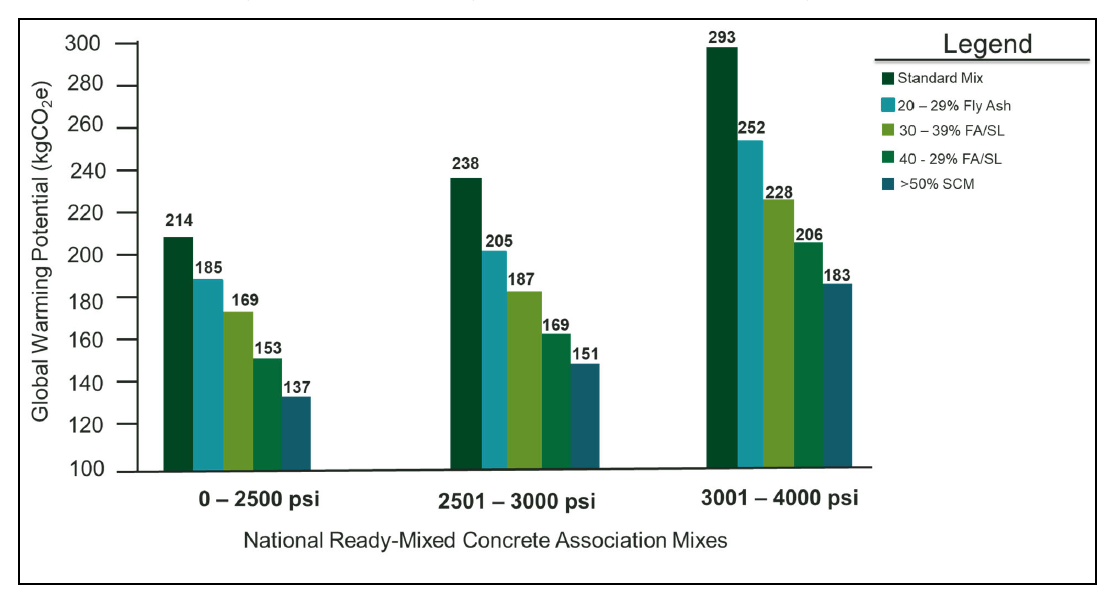
Concrete. The largest ECE contributions come from foundation walls, footings, slabs, and other concrete structural components. The study assumed all homes used a baseline National Ready Mix Concrete Association’s average mix , with a majority of the sample using a 3001- to 4000-psi standard mix (see chart below). Switching to a lower global warming potential (GWP) concrete mix could significantly cut each home’s ECE—the study found that the GWP of the most common concrete mix used in the sample was 46% higher than the lowest GWP alternative available.
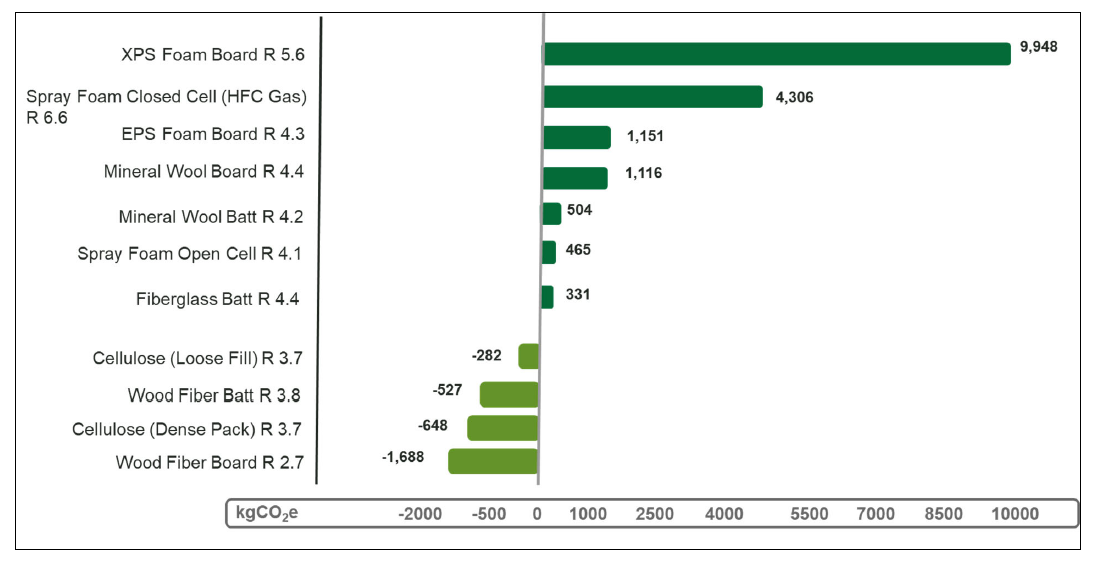
Insulation. The contrast between insultation materials is especially stark. XPS foam board carries a GWP of approximately 9,948 kg CO₂e per 1,000 square feet and closed-cell spray foam approximately 4,306 kg CO₂e per 1,000 square feet. Bio-based and cellulose-based alternatives, such as wood fiber board and dense-pack cellulose, store carbon, resulting in net-negative embodied emissions for those materials.
MEP materials. On average, MEP systems contributed more than 10 metric tons of CO₂e per home, representing 18% of total net ECE. Within the MEP category, mechanical systems (primarily HVAC) were the largest contributor at 12% of net ECE, followed by plumbing at 4% and electrical at 2%.
All-electric homes showed notably lower MEP-related ECE (7.6 tons) compared to mixed-fuel homes (11.3 tons), and ductless air-source heat pumps, in particular, have lower MEP-related ECE due to fewer distribution components.
High operational performance does not mean low embodied carbon
One of the study’s most striking findings is that embodied carbon intensity did not vary significantly by HERS Index score or Carbon Index rating. In other words, above-code homes are no better, on average, at limiting embodied carbon than conventionally built homes.
“Above-code homes are no better, on average, at limiting embodied carbon than conventionally built homes.”
In some cases, the additional materials used to achieve high operational performance may even increase upfront ECE. High upfront embodied carbon creates an emissions spike that even high-performing homes may need many years to balance out.
All-electric homes perform significantly better overall
Over a 25-year forecast period, all-electric homes demonstrated substantially lower total carbon emissions than fossil-fuel-dependent homes. On average, all-electric homes produced 60% lower total 25-year carbon emissions than fossil-fuel-only homes, and 52% lower than mixed-fuel homes. Electric homes produced the lowest operational carbon (57.7 tons over 25 years), while fossil-fuel homes produced the highest (180.6 tons). It’s not hard to imagine this gap widening further as the electrical grid continues to decarbonize.
HERS Raters as Embodied Carbon Assessors
A second major goal of the study was to test whether embodied carbon assessments could be practically integrated into the existing HERS Rater workflow, and the results look promising.
About 60% to 70% of the data needed for an embodied carbon assessment already exists in HERS Rater energy modeling files, suggesting that the incremental burden of adding an ECE assessment is manageable. Raters participating in the study reportedly adapted to the additional workload relatively quickly: After completing 5 to 10 projects, participants reduced their average completion time from 3.5 hours to 2.7 hours, and some Raters were able to complete the embodied carbon assessment in less than 2 hours.
Raters identified financial utility program incentives, rebates, and HERS score credits as the most important drivers for encouraging low-embodied carbon projects. They also emphasized that training and education would help build confidence in using lower-carbon alternative materials among builders and designers.
Looking Ahead
The study team acknowledges this is just a beginning. The sample of 100 homes, while sufficient to generate meaningful baseline estimates, is not randomly selected and does not fully represent the diversity of the statewide new construction market. The team calls for continued data collection to build a more robust baseline, expanded sample sizes, and broader regional representation.
Future research priorities identified by the team include sensitivity analyses for material substitutions, incremental cost comparisons for low-carbon materials, longitudinal tracking of new construction emissions, and, critically, addressing embodied carbon in existing buildings. Renovating and eventually replacing the existing housing stock represents both a major challenge and a major opportunity for emissions reduction that remains largely uncharted territory in embodied carbon research.
There is also important work still to be done on the tools themselves. Material emissions datasets, particularly for MEP systems, need to be expanded to improve accuracy. And the broader question of how to account for biogenic carbon—carbon stored in materials like wood or cellulose—remains an active area of methodological development. This study excluded carbon storage from virgin timber products due to ongoing uncertainty in accounting methods and concerns related to forestry practices.
Despite these limitations, the Massachusetts 100-Home Embodied Carbon Study makes a cogent case that the embodied carbon of new homes is both measurable at scale and substantial in magnitude. Notably, it establishes a verifiable baseline—the average of 55.5 tons of CO₂e in net embodied carbon per home per 25 years. Combined with the study’s conclusion that all-electric homes produce 60% fewer total 25-year carbon emissions than fossil-fuel homes, it’s clear that material choices and fuel sources determine much of a new home’s lifetime climate impact, and both must be part of any serious decarbonization strategy. The study also demonstrates a practical pathway forward: HERS Raters are well-positioned to integrate embodied carbon assessments into their existing work.
Read the full report here.