
When a client asked me to rehab a hunting cabin deep in the woods, I didn’t expect to step into a buzzing nightmare. After a long, dusty drive down a back road, I reached a small house near a lake, retrieved a key from the lockbox, and opened the front door—only to be greeted by a cloud of bees. I quickly slammed the door shut and called my client, explaining we couldn’t start work until the bees were gone. Unfortunately, someone had already tried a DIY fix, unleashing an insect bomb. Bee carcasses covered the floor, a needless slaughter that was ineffective at getting rid of the bees.
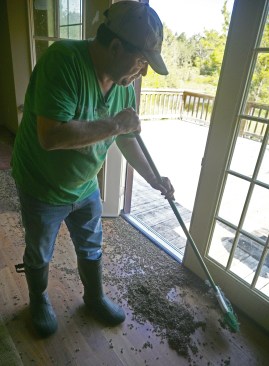
Arriving on site, the author found a killing field of bees perpetrated by a DIY attempt to rid the house of bees with an insect bomb.
Why Save Honeybees?
Many scientists consider the honeybee the most important species on Earth because of its vital role in pollinating plants, which is essential for the reproduction of many food crops and the health of ecosystems. A large part of our diet depends on crops that rely on bee pollination: no bees, no food.
Often regarded as simple insects, honeybees lead disciplined and diligent lives. Tens of thousands of female worker bees buzz in and out of a hive, foraging for food, feeding larvae, and building intricate combs of wax cells to store honey and protect the eggs as they develop into larvae and pupae, becoming fully grown bees in about two weeks. Their lifespan is brief, lasting only four to six weeks. To ensure the hive’s survival, producing offspring and feeding everyone are endless tasks. We can all learn from their discipline and hard work as builders and members of a cooperative society.
Unfortunately, honeybee populations are declining worldwide due to factors like pesticides and habitat loss, raising concerns about food security and our survival as a species. While killing honeybees isn’t illegal, it is harmful to humans in the long run.
Not like termites. Honeybees may sometimes nest in walls or attics, but, because of their ecological importance and the temporary nature of their hives, relocating them is worthwhile. They differ markedly from other invasive insects like termites, which cause continuous damage by eating wood and spreading rapidly through buildings. Unlike honeybees, which are crucial for pollination and ecological health, termites are destructive pests that offer no benefit to human-made structures. Usually, extermination is the only practical option for termites.
Not like carpenter bees. While honeybees are highly social, living in large colonies that produce honey and support pollination, carpenter bees and other solitary species behave differently. Carpenter bees bore holes into wood for nesting, which can cause structural damage, though usually less severe than that caused by termites. Carpenter bees don’t produce honey and are less vital to crop pollination, but all bees contribute to ecosystems through pollination. Green builders prioritize relocating beneficial bees, such as honeybees, while carefully addressing potential structural issues caused by carpenter bees.
The case for removal. Even if you don’t care about bees, there’s more to honeybee removal than just killing the invaders. A single colony can have up to 80,000 bees, making it tough to get rid of them all. They keep trying to find a way back, even chewing through wood and plaster if needed. Block one entrance, and they’ll find another. In addition, robber bees may come to steal honey from a weakened hive. New swarms might move in, and dead bees will start to stink. If bees die in hidden spots, you’ll have to deal with a strong smell for many months.
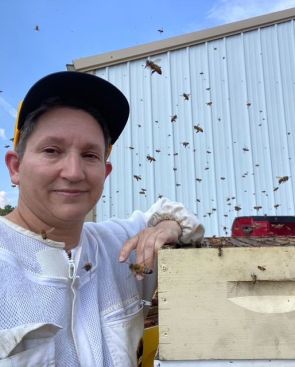
Meet Nanette Davis, the queen bee of Garden Variety Bees. In addition to moving bee hives, she teaches teens about beekeeping with the MoCo Beekeepers, mentors in the Hives to Heroes program, and serves as a behavior analyst helping families near Houston.
Besides the bees, honeycombs hidden inside walls or ceilings can cause structural problems. I knew honeycombs were probably hidden behind the drywall in my client’s cabin. Unless we removed those, a sweet, sticky mess would remain in the walls, attracting other creatures as well as members of the original colony. Honey and wax can also seep into wooden framing, leading to potential mold growth, wood rot, or rodent or secondary insect infestations. Over time, the added weight and moisture inside walls can weaken the structure of insulation, drywall, and even electrical components.
The Proper Way to Evict Honeybees
After I made some inquiries, a friend of a friend recommended calling Nanette Davis at Garden Variety Bees. Nanette, a master beekeeper, agreed to examine our situation. We met a few days later, and she was shocked to see the area scattered with dead bees. “I’ve never seen so many dead bees,” she said, with a hint of sadness. Still, many bees were still buzzing around, flying in and out of a small opening in the ceiling. “This was once a massive colony,” she noted.
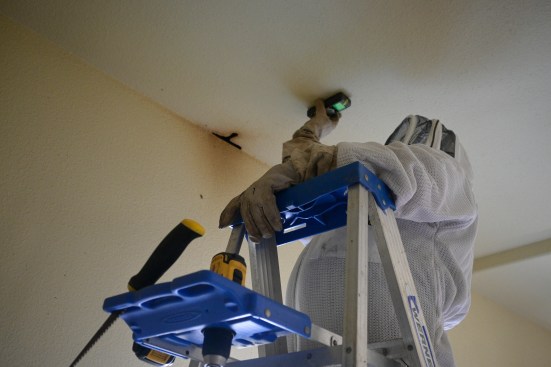
Nanette used a thermal imaging camera to detect a heat signature and determined the hive was in the ceiling. We decided to wait until the weather cooled so the bees would be calmer and the work less uncomfortable, since the house was in Houston and lacked air conditioning.
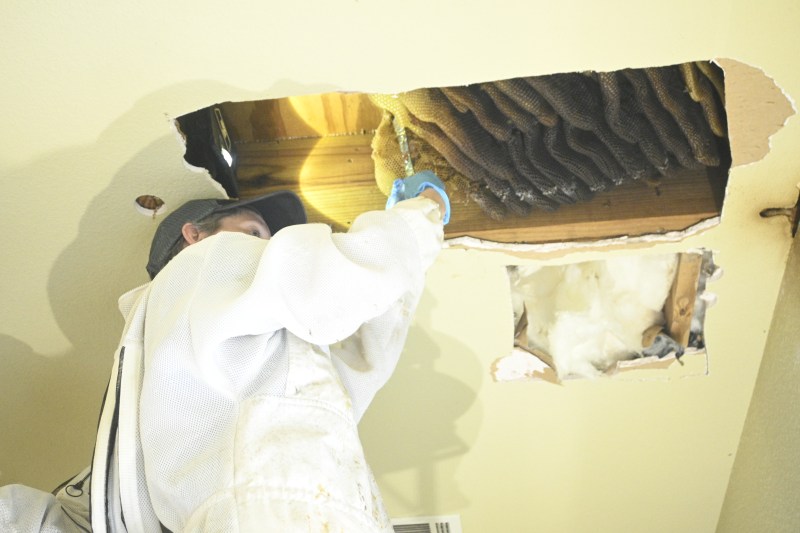
A few weeks later, Nanette came back with her assistant and life partner, Scott Davis. They showed up at the jobsite like any other subcontractor, unloading ladders and equipment. Their tools included hive boxes with frames for moving panels, bee vacuums to safely extract the insects, hive tools that look like paint scrapers, buckets, a bee smoker to calm the honeybees, and protective jumpsuits, gloves, and veils, with extras for me and my crew. Beekeepers aren’t allowed to do demolition work in many areas, so I was responsible for cutting into the walls.
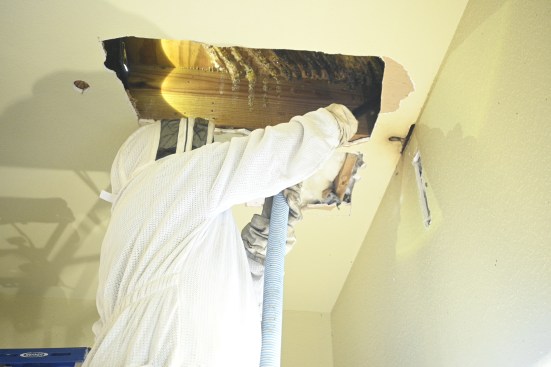
Beekeepers operate under numerous regulations and registrations to protect the safety of both the bees and the public. In Texas, pending legislation suggests mandatory training and licensure for a “Bee Removal Professional.” It’s a serious trade. I set up the ladders and drilled a few holes into the ceiling. Nanette used a fiber-optic inspection camera to confirm the hive’s exact location. Fully suited, I climbed the ladder with jab saw and battery-powered Sawzall in hand and carefully started demolition.
Opening up a ceiling isn’t difficult for a contractor like me. However, beekeepers, though they might know a lot about insects, don’t necessarily know much about building hazards like electrical wiring or plumbing, and cutting into a house isn’t part of their job. Laws differ across areas, so it’s always best to hire a professional with the right equipment and knowledge to do the removal and follow any required protocols. A licensed professional should always handle opening building parts for hive access.
As the first sheet of drywall peeled off, I caught my first glimpse of the hive. It didn’t look as I expected; I initially thought it was foam insulation. Honeycombs often hang vertically; in this case, they were suspended from under the subfloor of the second story. The combs resembled radiator panels designed for air circulation in summer and heat preservation in winter. Looking closer, I noticed the hexagonal structure of the individual cells. Bees build hexagons because they mesh together perfectly, like an endless puzzle, leaving no gaps between cells. It was time to let the expert take over.
Preparation
When preparing a site for hive removal, contractors should take proactive steps to protect the property and ensure crew safety. For example, block re-entry points to prevent bees from entering the interior and seal off surfaces prone to honey leakage. Lay down a drop cloth to prepare for a sticky mess. These steps are crucial to avoid staining, honey odors, and secondary damage that could require more extensive repairs. Also, be careful with ladders, as honey dripping on rungs can cause a fall.
The Gentle Art of Honeybee Removal
Though we exposed the hive and shook the structure while cutting, the bees remained surprisingly calm. While there are about 4,000 native bee species in the United States—800 of them in Texas—there was no doubt about the species here: the Western Honeybee, Apis mellifera, the only bee in the country that produces honey. And there was plenty of it. As Nanette carefully scraped each panel from the subfloor, honey poured down her hands and arms onto the ladder rungs and the floor. It’s a sweet but messy job.
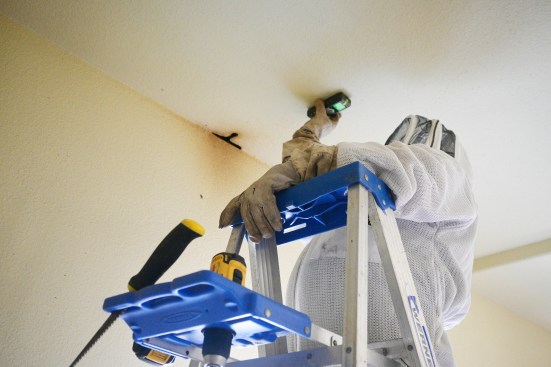
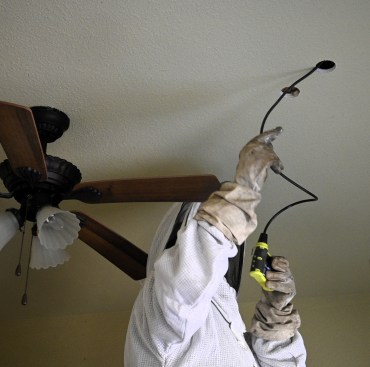
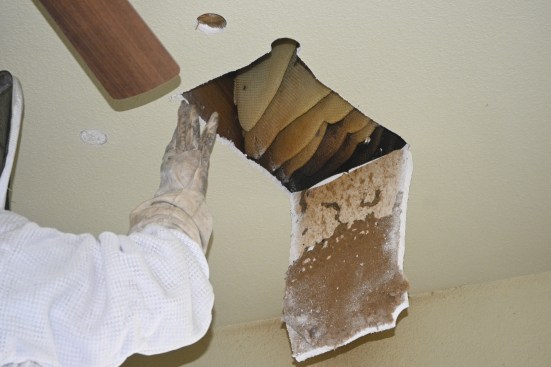
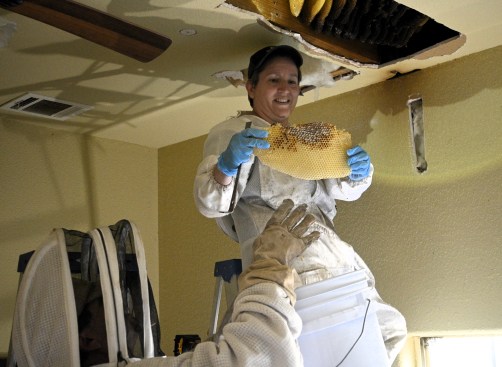
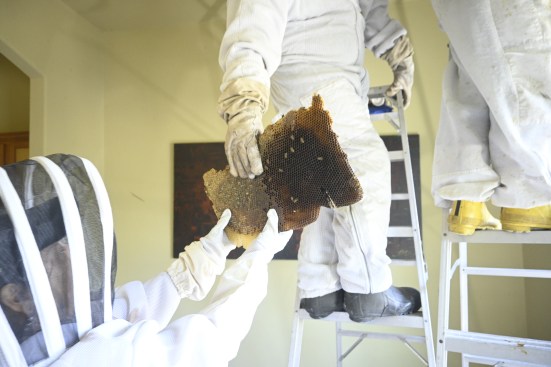
Nanette removed her veil because the bees seemed unbothered. She complained about the heat and preferred the occasional sting over eight hours of sweating in a hood while carefully working overhead to remove each panel. At one point, she got stung. Some bees can become aggressive and swarm, but bees generally sting only as a last resort. After a worker bee stings a mammal, the barbed stinger can get stuck in the animal’s skin, tearing loose from the bee’s abdomen and leading to her death within minutes. It’s a kamikaze mission. Bee venom contains histamines and proteins that can cause allergic reactions in some people, but, for most, a sting is just mild discomfort.
Collaborating With Professionals
Working with licensed bee removal experts, such as master beekeepers, is essential for handling hive removal’s structural and ecological challenges. These experts use tools like thermal cameras and fiber-optic scopes to safely locate hives without damaging other parts of the building. Beekeepers also help prevent DIY efforts that could worsen the problem and lead to unexpected repair expenses.
Smoke and Dance
When a bee stings, it releases alarm pheromones that attract other bees and prompt them to defend the hive. An angry swarm would have interrupted our work. To keep things peaceful, Nanette asked Scott to bring the smoker, a device that looks like an old oil can with a bellows attached. Smoke is produced in a fire chamber using wood chips, dried leaves, or grasses. Scott climbed the ladder and pumped the bellows, releasing smoke onto the hive. Soon, the bees’ buzzing quieted, and the threat of an angry swarm diminished.
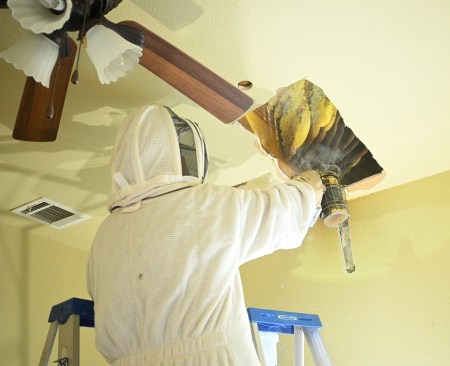
Scott Davis uses a smoker to calm the bees during removal.
Bees communicate their locations and resources through what Nanette called the “waggle dance,” an intricate movement that guides colony members to food sources. This behavior also helps beekeepers identify where bees are settling in human structures. Before deciding where to drill for the inspection camera, Nanette used a stethoscope to listen for buzzing. The rapid beating of the bees’ wings generates the buzz and enough airflow to ventilate the hive and dehydrate the honey. Once the honey reaches a moisture content below 18.6%, it is “ripe” and stored in wax-sealed cells for long-term preservation. Bees live off their stored honey stock through the winter when the nectar of flowering plants is unavailable.
Although bees produce buzzing sounds, they don’t communicate with them because they can’t hear. Instead, they communicate through pheromones and dance. Different dances send different messages. A round dance indicates nearby nectar. A bee stamps her feet and wiggles her body when she needs grooming. There’s even a “massage dance,” where the bee moves her head to attract attention, and other bees respond by gently pulling her legs and rubbing her body. The alarm dance warns other bees of danger, and Nanette tried to calm this instinct with the smoker.
As Nanette continued removing honeycomb panels, she commented on their condition. She pointed out brood cells covered with a wax lid. Healthy broods are uniform, with brood cells lined up neatly, covering large sections of the comb. Queens are careful about how they lay eggs when everything is healthy. A scattered or “shotgun” pattern shows an unhealthy brood. Nanette shook her head, doubting the queen had survived the poisoning. She pointed to small peanut-shaped structures at the edges of some combs, explaining these are “practice queen chambers.” The bees build these chambers to practice their skills, even if no queen will use them.
Nanette asked us to step outside and look through a honeycomb into the sun to see the details of the symmetrical hexagonal pattern, which perfectly combines architectural form and function. Despite the honeycomb’s fragile appearance, the interlocking hexagonal cells create a strong structure. It’s surprisingly heavy. Charles Darwin once observed that bees’ ability to build perfect honeycombs was “the most wonderful of all known instincts.” Each hexagonal cell is so precisely made and neatly arranged that it’s a visual delight.
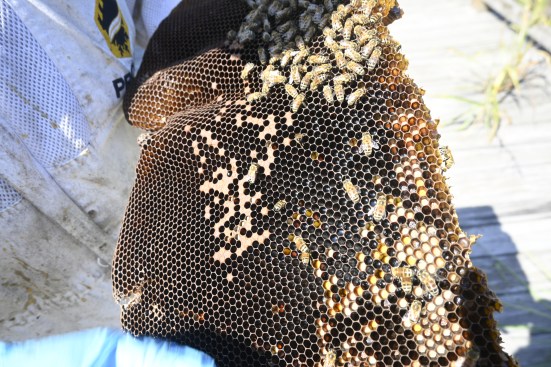
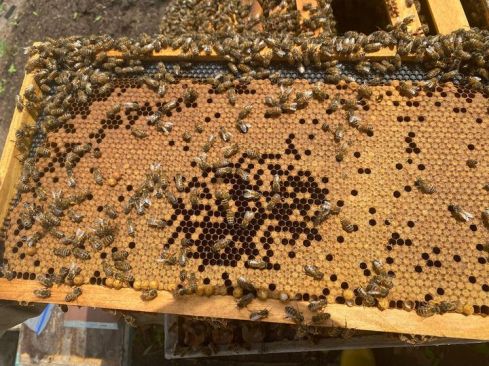
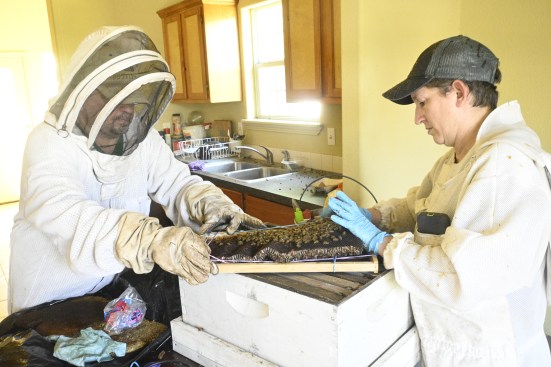
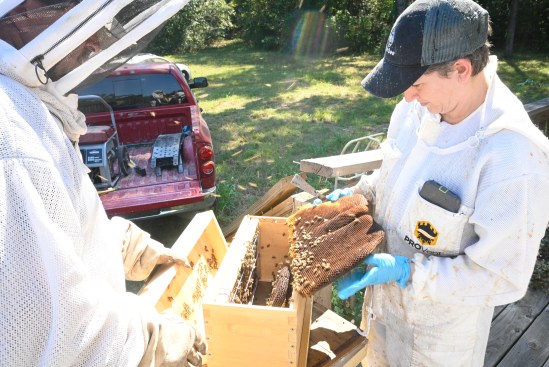
The capped cells in this honeycomb panel are brood pods where la…
Post-Removal Repairs and Restoration
After removing the panels, Nanette and Scott cut and placed them in wooden frames, securing each with rubber bands. These frames slipped into a slotted box for transport.
Once she placed all the panels safely in their frames, Nanette carefully scraped off all the wax and honey from the underside of the subfloor and joists. Any leftover residue could attract the bees that weren’t in the hive; most were out foraging, so many would return looking for their home. With the hive gone, I could clearly see where the bees had entered through a gap between the cantilevered balcony joists and the floor framing. They had built their hive in the spot where the builder forgot to fill the joist bay with insulation. I sealed this crack with caulk and made a mental note: Always seal around joists and never forget to insulate.
Scott then brought out spray paint to seal the wax stain on the wood framing and kill any remaining odor. Odor-blocking paints, like Big D Odor Eliminator and Kilz, are also used in smoke-damage restoration and work better than standard sprays.
If the colony hadn’t been poisoned, Nanette would have left a panel outside to attract foraging bees and prevent them from re-entering the house. But she was concerned the poison would harm other bees in the area. Likewise, the honey in the combs was inedible because of the poison. Uncontaminated honey, however, has extraordinary medicinal properties.
Honey has been a valued natural remedy for thousands of years. Ancient civilizations, such as those in Indian Vedic culture and China, appreciated honey for its antibacterial, anti-inflammatory, and antimicrobial properties. Honey has been used to heal wounds, digestive problems, and sore throats. Modern research shows that honey’s antioxidant qualities help treat and prevent degenerative diseases. Honey is also a natural antiseptic that speeds up the healing of cuts, burns, and other injuries.
Limited Chance of Survival
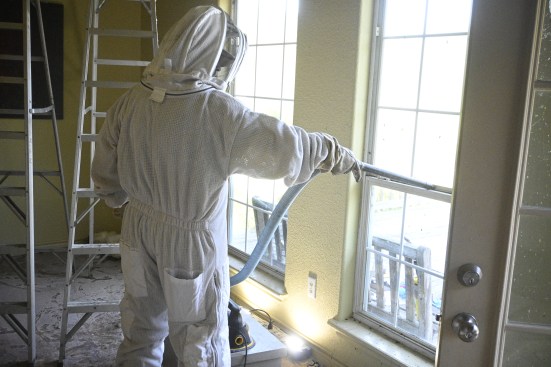
To complete the extraction, Scott used a “Colorado Bee Vac” to gently suck the bees through a tube into a screened box with plenty of ventilation. It felt like an endless task; no matter how many bees Scott removed, new ones kept flying into the house through cracks. Eventually, nearly all the bees were gone, except for the thousands gathered outside, attracted by the smell of honey. Soon, the panel box and the bee-vac box were loaded onto the back of the beekeepers’ pickup truck, along with the rest of the equipment, and we were ready to lock up and move the bees to their new home. Nanette and Scott took care that no bees got into the cab, as driving with a swarm could be dangerous.
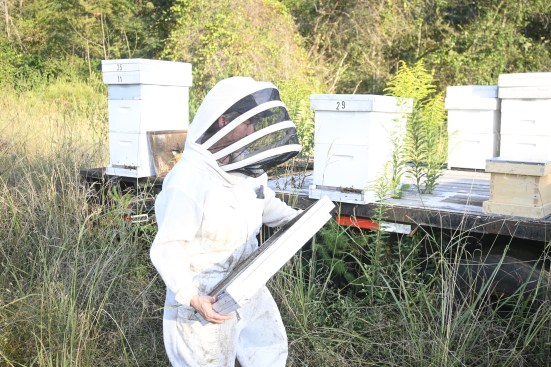
After about a half-hour drive, we followed the beekeepers to a field where several hives were stacked on trailers, elevated above the ground to prevent flooding. The pair suited up again, as dropping bees into their new home can provoke anger and swarming. We kept a safe distance and observed.
When I asked Nanette about the bees’ chances for survival, she wasn’t optimistic. Because we had moved more than 4 miles away from their original hive, the bees wouldn’t easily be able to find their way back, especially without a queen and with a weakened colony due to the insect bomb. The survival rate for relocated bees is very low. Our swarm had taken a serious hit from the poisoning and had lost its queen. Nanette would watch the bees and decide whether it made sense to introduce a new queen.
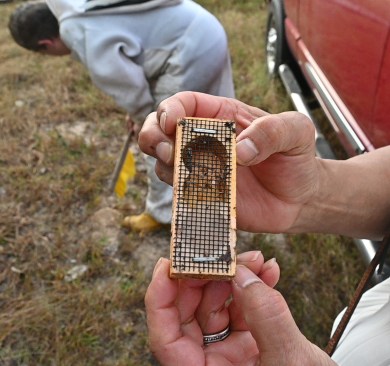
Introducing a new queen is delicate because the bees may kill her. The new queen is placed in a small cage with three worker bees as attendants. The cage protects her while the rest of the colony gets used to her pheromones. A small hole blocked with hard candy at one end of the queen’s cage takes the bees about five days to chew through. This period allows the colony to accept her scent. Once the candy is gone, the queen is released to start laying eggs, and if everything goes smoothly, the colony is re-established.
Coexisting With Nature
Removing honeybees from the hunting cabin reminded us of how deeply connected we are to nature, even when it unexpectedly invades our spaces. Bees aren’t just tiny pests to eliminate; they’re vital for our ecosystems and food systems. Proper bee removal goes beyond solving a pest problem—it’s about recognizing the important role pollinators play in supporting life on Earth.
When facing a similar situation, consider working with professionals who focus on safely relocating bees, ensuring their survival while protecting your property. This approach helps maintain ecological balance, one hive at a time.