
The first rule of ducts in roof and wall cavities is “don’t.” But, as remodelers, we don’t always get our every wish.
We have found a couple of ways to install insulation above or behind the ducts when we are forced to put them in rafter or stud bays. These approaches are not rocket science, but if you discuss the options ahead of time with trade partners and crew members, you can get a much better result than if you just ignore it and hope for the best.
Avoid Exterior Framing
A bunch of savvy HVAC engineers have started using a technique that can make it possible to avoid running ducts in exterior framing altogether: Install supply registers closer to the middle of the house and rely on the “Coandă effect” to help deliver the air to an exterior wall across the room. The Coandă effect is the physical principle that moving air will “cling” to an adjacent surface like a ceiling or wall instead of dropping straight down.
In modern houses with today’s excellent windows and wall insulation, it’s nowhere near as important as it used to be to blow HVAC air directly on windows or exterior walls. Because a flow of air will follow a ceiling for many feet before dropping down into the room, a ceiling or high wall register 10 or 15 feet from the exterior can still deliver most of the same Btus to the exterior surfaces. In plenty of houses, an interior-area register near the ceiling can perform about as well as a duct near the window. In that case, no ductwork in rafter bays is even needed.
When You Can’t Avoid It
However, this approach doesn’t always fit the project. For example, sometimes there are interior walls or other immovable elements that obstruct the flow of air. In these instances, we have two things to solve:
1) Make room for insulation outboard of the duct, and
2) figure out how to install it given that insulation crews normally do their work after the ductwork is installed.
To make room, we’ve used two general approaches: The first is to select shallow ducts that leave lots of room for insulation behind them. The second is to use round ducts, which allow us to install adequate insulation over most of the area.
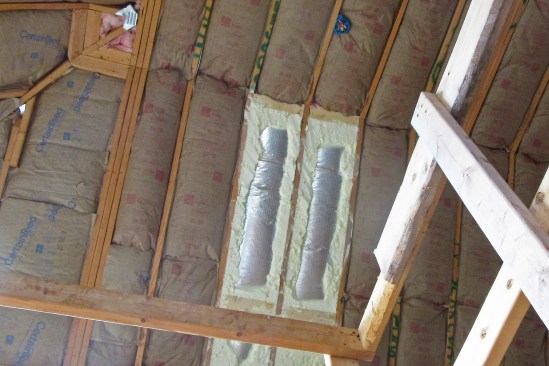
Rather than being run as one large rectangular duct, this line was split into two smaller round sections of flex duct that allowed ample closed-cell spray foam to be installed around them.
Split ’em up. A complex but sensible method is to split ducts up into multiple smaller sections so they fit better. We sometimes have rooms like a bathroom or closets situated on the opposite side of an attic from the HVAC equipment and have been directed to run ductwork over a cathedral ceiling to get there. Instead of a single 6×12 trunk duct that almost completely fills a 2×8 rafter bay, we can branch off early and put in four 5-inch round ducts. These are much easier to insulate above and around.
Round ducts. Even after a single round duct in a rafter bay is in place, we can usually insulate above and around it with spray foam or fibrous insulation. This simplifies scheduling and even allows more thickness of insulation above it compared with a larger rectangular duct. A competent designer needs to calculate the size of the new ducts, but that’s usually straightforward. Since, as noted, a single round duct usually doesn’t get in the way of installing insulation, it’s an optimal solution from a scheduling standpoint.
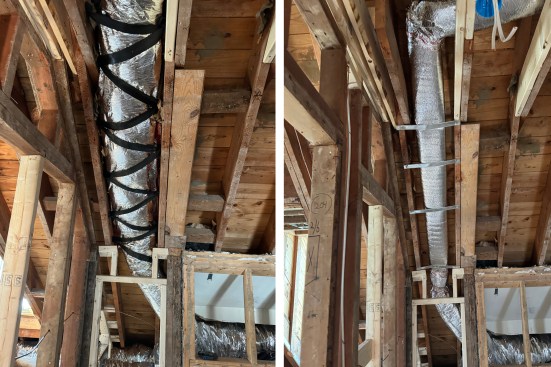
The flex duct on the left filled the whole cavity, leaving no room for condensation-controlling insulation above the duct and little room to install any insulation in the bay. The author’s HVAC partner switched it out for a section of metal duct (right). That made it possible to apply closed-cell spray foam between the duct and the sheathing and to fill the cavity, which provided condensation control on the duct.
We’ve found that flex duct can also make things even easier when we can use large enough sections; flex duct’s pre-applied insulation makes easy work for all involved.
Spray foam. Or we can leave the ducts bare and spray them with closed-cell foam on all sides. This provides both condensation control on the duct as well as envelope insulation.
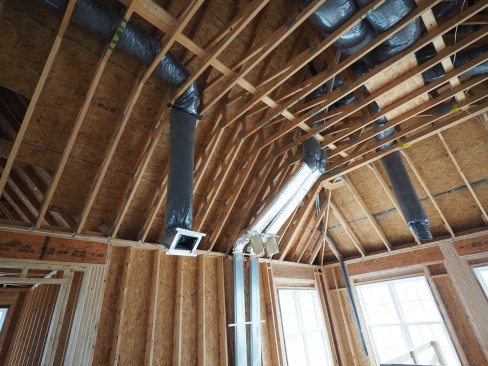
Let ’em hang. Another method we often use is to leave the ducts out of the cavities until insulation is placed. Our HVAC folks are usually open to the idea of leaving ducts hanging down and connecting them later. Sometimes, our carpenters attach the three or four pre-positioned straps after insulation without requiring the duct people to make an additional trip to the jobsite.
Doug Horgan
At left in the photo above, a section of flex duct and boot has pre-attached straps for final installation after insulation. At right, two rigid metal ducts are similarly set up with straps that will be used to attach the duct after the cavities have been insulated
We can also avoid a special trip from the HVAC folks when we leave ducts disconnected in an accessible space and connect them later. Or the HVAC crew can make up some sections of hard pipe for us to place while we are insulating. Leaving ducts partially connected and hanging from the final straps makes it clear what will need to happen later. We haven’t had issues with the insulation folks not understanding and accidentally overfilling bays or anything like that. We do depend on our full-time supervision to manage these steps, but it’s simple enough that I would think it could work even without that.
Rigid foam. We’ve also installed foam board or spray foam before the HVAC rough-in even starts. A common situation is to have a couple of ducts running in rafter bays for less than 8 feet. It’s not hard to fit a sheet of poiyiso or XPS foam board up against the roof sheathing and seal the perimeter with a can of sealing foam. Then ductwork can be installed in the normal timing, and the insulation crew can fill in around the sides during their normal visit.
Well-sealed foam board, with its high insulating value and moisture retarding qualities, is a good option above ductwork. We do make sure to avoid EPS foam in this application in our climate (Virginia), since EPS does allow moisture transmission, and we would prefer to block most of that.
Closed-cell spray foam can be used the same way, though it’s an unusual project where we bring a spray rig in before HVAC ductwork is run. The way we more often use closed cell is to spray all the way around round ducts. Closed-cell foam can be used as duct insulation, so if we can size the duct right, we can make it possible to insulate above and all around it in one operation.
Best case, though, as mentioned at the beginning, is to never have ducts in exterior framing cavities.