
The “mutant material” revolution that MoMA curator Paola Antonelli investigated in the 1995 exhibition “Mutant Materials in Contemporary Design” has taken an ecological turn. So-called mutant materials are those that defy traditional paradigms and expectations, such as ceramics that behave like metals or plastics with the rigidity of stone. While Antonelli’s selections primarily represented technical and aesthetic departures from the norm, today’s mutants increasingly exhibit unexpected, and often significant, improvements in environmental performance.
The following emerging materials include biobased and abiotic surrogates for everyday building products and assemblies, pointing to a promising future in ecological construction. These examples were either recently commercialized or will be available momentarily, and collectively, they offer a compelling indication of how the next generation of building products could shape the built environment in 2026.
Superwood
The renaissance currently underway in wood, driven by the material’s low embodied carbon and the burgeoning mass timber movement, has led to intriguing developments. A notable example is Superwood, developed by InventWood, a Frederick, MD-based company. As its name suggests, Superwood’s capacity is uncommon. According to the manufacturer, the material offers between four and twenty times the mechanical strength of wood while being six times lighter than steel, with a strength-to-weight ratio up to ten times that of steel.
The product also exhibits up to 10 times the wood’s dent resistance and is Class A fire-rated. This high performance is enabled by removing lignin and by densifying and reorienting cellulose fibers in natural wood. If commercialization is successful, Superwood could measurably expand the use of wood products in structural and semi-structural applications—especially in high-performance envelopes, prefabricated assemblies, and products typically considered for steel. InventWood is currently manufacturing Superwood for applications like decking and cladding, with new orders anticipated this year.
EcoCocon
Another high-performance, carbon-sequestering product is EcoCocon. The novel wall system incorporates an unexpected primary material: straw. Straw has been used in buildings throughout history, in straw-bale construction of timber-frame infill, and has assumed both structural and insulating roles.
The difference with EcoCocon is that it is a prefabricated system that achieves both functions. Compressed straw serves as the core insulating material, encapsulated in a vapor-permeable membrane that allows moisture to pass through, while a wood stud frame provides load-bearing capacity. The outer skin is sheathed in wood fiber cladding, while the interior surface is finished with clay plaster. The engineered assembly raises the precision of a material like straw to the level of other high-tech envelope systems.
Notably, 98 percent of Ecococon consists of renewable materials, which sequester significant carbon, and it lacks thermal bridges that can lead to energy inefficiencies and unwanted moisture accumulation. In this way, the system serves as a model for biobased, regenerative prefab construction. Launched in Europe, EcoCocon has expanded into the U.S. market, with increasing adoption in net-zero construction and modular housing.
MycoWood
Once a novel material in building products, mycelium has become a more common natural binding agent across a variety of materials for design and construction. Mycelium-based biocomposites are typically thick, lightweight, and structurally weak—well-suited for packing materials or acoustic insulation.
However, Comulabs has developed a mycelium-based alternative to wood products such as plywood and MDF. Like other mycological products, the mycelium and agricultural waste biocomposite is grown rather than manufactured in a traditional sense, resulting in a formaldehyde-free, compostable product that resembles wood in its aesthetics and workability. The locally sourced material requires just one week to grow and is quickly compressed into panels.
Compared with traditional wood product manufacturing, MycoWood’s microfactory paradigm is a dramatically swifter and less environmentally impactful process than growing, felling, transporting, and processing trees in energy-intensive lumber mills. Comulabs’ innovation introduces a new model of on-site or regional production that uses shorter supply chains, supports distributed manufacturing ecosystems, and reduces transportation emissions.
ESM
Another sustainably minded mutant material is the newly developed enzymatic structural material (ESM), a concrete-like substance that materializes out of thin air. Scientists at Worcester Polytechnic Institute (WPI) developed a novel concrete surrogate by significantly reducing the energy-intensive clinker manufacturing and time-intensive curing processes.
Engineer Nima Rahbar and his research team utilized an enzyme that solidifies CO2, transforming the gas into mineral particles. A particle-binding and curing process produces a moldable material that can reach its final state in hours, rather than weeks, compared with conventional concrete.
Because the mineral basis of ESM emerges from the atmosphere, the material functions as a carbon-capturing machine. “Producing a single cubic meter of ESM sequesters more than 6 kilograms of CO2, compared to the 330 kilograms emitted by conventional concrete,” said Rahbar in a WPI press release. Performance-wise, ESM is comparable to structural concrete, achieving an average compressive strength of 25.8 MPa. Its rapid constructibility and repairability make it a compelling candidate for adaptive reuse, repair, and new construction. “If even a fraction of global construction shifts toward carbon-negative materials like ESM, the impact could be enormous,” Rahbar added.
Pretty Plastic Panels
When it comes to second-life materials, plastic is usually top of mind. Polymers such as PET, found in products like consumer beverage containers, are readily recyclable. However, plastics used in building construction are not so readily repurposed at the end of life. PVC, the most common polymer in construction, has typically been landfilled or burned, with a recycling rate in the low single digits.
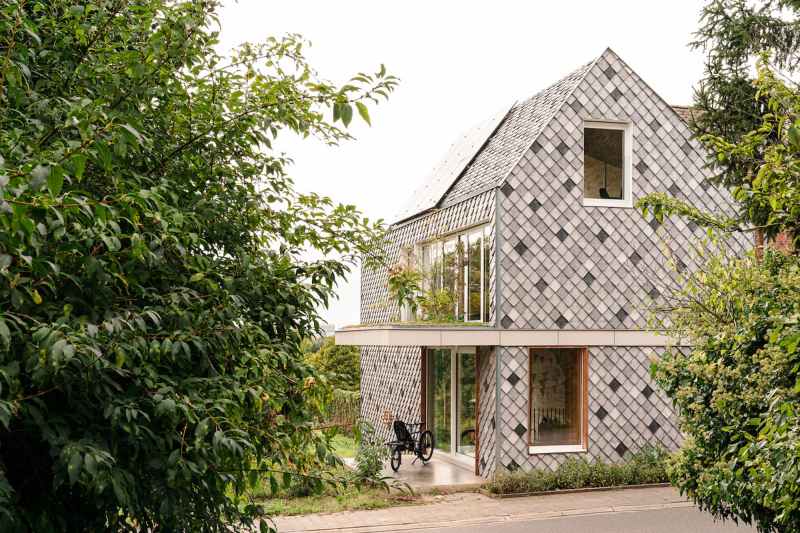
However, manufacturer FRONT (formerly StoneCycling) has developed effective methods to recycle PVC building components, such as discarded window frames, rain downspouts, and other products, into new cladding modules. The company’s Pretty Plastic Panels are made from 100% PVC reclaimed from construction waste. The PVC refuse is collected, converted into pellets, colored and tinted, heated, and pressed into molds. The resulting modules, suitable for cladding and other exterior applications, strike an aesthetic balance between homogeneity and variety.
A field of multiple PPP units appears uniform from a distance but variegated up close, as no two panels are alike. Recently commercialized in the Netherlands, the product has already been installed on several building facades across Europe. Pretty Plastic Panels solve a longstanding problem with PVC recyclability, promising to transform a significant culprit of plastic waste into a new resource for global construction.