
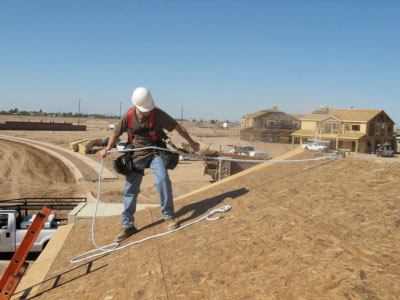
Concerned about a reported 26% rise in work-related falls between 2011 and 2016, researchers at Virginia Tech and Clemson University studied why recent safety interventions and technological advances in fall protection have not been as effective as hoped. They suspected that a latent side effect of safety interventions, a cognitive bias known as “risk compensation,” was offsetting some of the safety benefits of fall protection equipment. To test their theory, the researchers assembled what they called “an immersive mixed-reality environment” to simulate a roofing activity, then equipped study participants with virtual-reality headsets and real-time head- and ankle-tracking sensors to monitor their behavior while they completed various roofing tasks.
As reported in “Latent Effect of Safety Interventions,” published in the ASCE’s Journal of Construction Engineering and Management, and in “Construction Workers Take More Risks When They Feel Safe—and Still Get Hurt,” published in Popular Mechanics, what the researchers found is that the safety equipment tended to produce a sense of invulnerability, or false sense of security, that increased the study participants’ risk-taking behavior by up to 55%: They stepped closer to the roof edge, leaned over the edge, and spent more time exposing themselves to fall risk. To make sure that workers aren’t relying on cognitive biases and jeopardizing their own safety, researchers suggest that a new kind of training or monitoring system may be necessary.